

Tuesday, April 16, 2013
This story was reported by Andy Bromage and Kathryn Flagg
Peter Teachout was 100 yards from the finish line at the Boston Marathon when he heard a loud boom, then saw a huge puff of smoke.
"I thought it was a celebratory finish-line gun. Or maybe one of those World War 2 cannons they shoot off to celebrate the finish line," said Teachout, a Norwich resident and Vermont Law School professor. "We kept on running."
About 50 yards from the finish, just a few seconds later, the second bomb went off. At that point, Teachout said the runners in front of him turned around and started running toward him in panic. Teachout continued toward the finish — reflexively — until he saw injuried people lying in the roadway.
"They were clearly cut up," said Teachout, who was not injured in the blasts. "It really was surreal. It was like what you see in videos or films about terrorist attacks."
Teachout, 72, was one of 100 Vermonters registered in yesterday's 26.2-mile race. A longtime marathoner who once finished fourth in his age group at Boston, Teachout says he was having a "lousy" race. He lost a month of training owing to a recent surgery. He was on pace to finish somewhere around 4 hours and 8 minutes. Any faster, and Teachout might have been among the three dead and more than 100 injured in the bombings.
"I'm lucky I didn't run a minute faster," Teachout said by phone from his daughter's house in Boston.
A St. Michael's College graduate is a member of a New York Times team that on Monday was awarded a Pulitzer Prize for explanatory reporting.
Jonah Kessel, who graduated from St. Mike's in 2005 and from Champlain Valley Union High School in 1999, won recognition for his work as a videographer in a series of Times stories about the business practices of Apple and other computer firms. Entitled "The iEconomy," the series included stories on how cheaper factories in China were chosen over U.S. manufacturers to produce the iPhone. Kessel, 32, made two videos about those factories in China, where he works for the Times and other news organizations.
Interviewed on Tuesday by phone at his parents' home in Shelburne, where he is staying before returning to China in a few days, Kessel called the experience of sharing in journalism's highest honor "a bit surreal." He added that it was "an honor I was not expecting."
But Traci Griffith, chair of the St. Michael's Media Studies, Journalism & Digital Arts Department, said "it's not surprising" that Kessel's work has been recognized by Columbia University's Pulitzer committee. Griffith recalled Kessel's senior seminar project, which took the form a co-produced website on the loss of the Abenaki language in Vermont.
"Jonah is gifted," she said. "He was the sort of student who never had to be pushed to experiment or to move beyond where he was comfortable."
Kessel's father, Herb Kessel, works as an economics professor at St. Michael's.
Griffith noted that it's the first time a St. Michael's alumnus has been awarded a Pulitzer.
Kessel said that while the Times sponsors his visa for China, he is not a fulltime employee of the newspaper, which won three other Pulitzers on Monday. The Times did offer him its congratulations in an internal communication, Kessel added.
Monday, April 15, 2013

The fight over whether to base next-generation F-35 fighter jets in Vermont landed on the front page of the Boston Globe Sunday.
The focus of reporter Bryan Bender's above-the-fold story is whether Sen. Patrick Leahy — "one of the National Guard's most powerful political allies in Washington" — used his clout to secure the F-35 squadron for his home state.
Bender's answer appears to be yes — and he's got at least a couple insiders who say the same. The Globe scribe quotes an anonymous Pentagon official "directly involved with the review" of base criteria, who says in no uncertain terms that the Air Force cooked the books to please Leahy:
One of the Pentagon officials said in an interview that the lengthy base-selection process was deliberately “fudged’’ by military brass so that Leahy’s home state would win.
“Unfortunately Burlington was selected even before the scoring process began,” said the official, who asked that he not to be identified for fear of reprisals from his superiors. “I wish it wasn’t true, but unfortunately that is the way it is. The numbers were fudged for Burlington to come out on top. If the scoring had been done correctly Burlington would not have been rated higher.”
Bender's Pentagon sources — he makes clear there's more than one — tell him that the Air Force made several "errors" in its initial base review, and one source insinuates that the errors may have been intentional:
“It would be more costly to do these missions at Burlington,” one of the officials said. “They came up with this scoring model to be independent and stand up to scrutiny. But political promises were made.”
This isn't the first time an anonymous military source has cast doubt on the Air Force's base selection process.
Pay your taxes!
Here's what's happening in Vermont news and politics this week. Got a newsworthy event for next week's calendar? Email by Friday to submit.
Monday, April 15
- At 10 a.m., Burlington bigwigs (mayor, police chief) and law enforcement will hold a press conference at the U.S. Attorney's office in Burlington on the "heroin epidemic," which has rather suddenly replaced prescription opiates as the scourge of Vermont.
- That whole assault-weapons ban in Burlington thing? The city council's charter change committee takes it up today. At the very convenient time of 11:30 a.m. in city hall.
- Vermont's health care reform is important — but damn confusing. Hear Mark Larson, director of the Office of Health Care Access, explain it live at 5:25 on Channel 17.
Rest of the week after the break...
Sunday, April 14, 2013
Federal, state and local law-enforcement officials have scheduled a Monday morning press conference in Burlington to outline new initiatives against the growing use of hard drugs in Vermont and the crimes associated with them.
The current scope of these problems "is like nothing any of us have ever experienced," a police chief with 30 years' experience in the state told a neighborhood meeting in Burlington last week.
Lianne Tuomey, head of the 24-member University of Vermont police force, added that methamphetamines have become part of the mix of illegal drugs used on the UVM campus and in the rest of the city. "We mirror the culture from which we come," Tuomey said in regard to drug use among UVM students.
Many local opioid addicts have switched to heroin from Oxycontin, a prescribed pain-killer, Burlington Police Chief Mike Schirling (pictured) said at the Ward 6 Neighborhood Planning Assembly meeting on April 11. The reason, he explained, is a change made in the Oxycontin formula by its manufacturer, Purdue Pharma, that has diminished the drug's attractiveness to abusers. Oxycontin has been re-engineered to decrease its potency when snorted or injected — which had been favored modes of ingestion among those seeking quick highs.
Heroin use has consequently burgeoned in Burlington, Schirling said. And the expense of maintaining this habit has fueled the upsurge in burglaries in the city during the past couple of years, he added. Schirling said a "mid-level addict" requires as many as 15 bags of heroin per day, each of which retails for $20 in Burlington. That equates to a yearly cost of about $100,000.
"That's what's driving these issues," Schirling said in regard to the rise in burglaries and other thefts in Burlington. "The No. 1 driver is opiate addiction." The BPD has had "some significant successes" in burglary-related arrests, the chief continued. But by way of analogy to the crime/drug "epidemic" in the city, Schirling added, "We're plugging fingers into lots of holes in a gigantic dam."
Friday, April 12, 2013
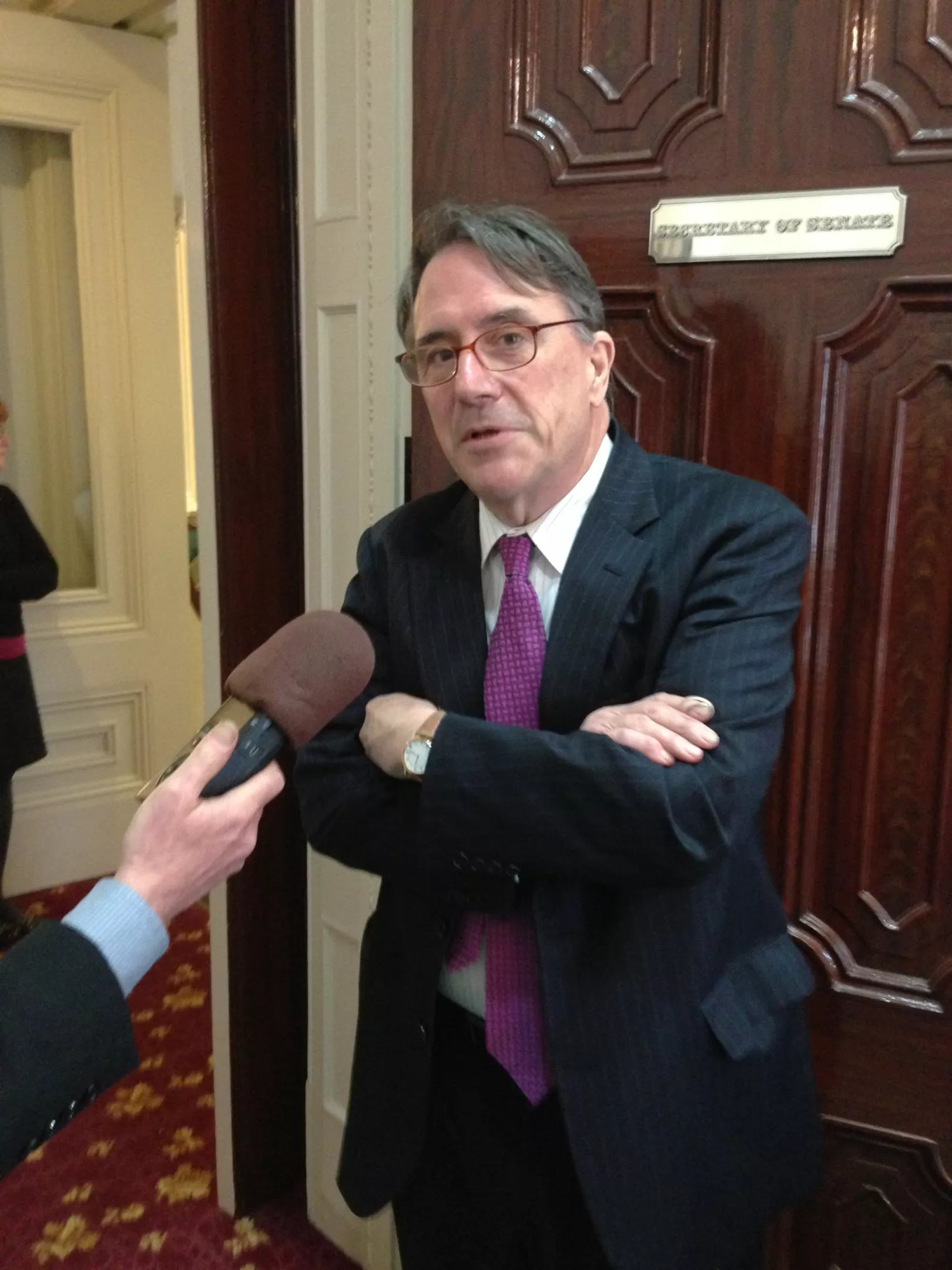
A years-long debate over whether to update the state's campaign finance laws came to a surprisingly swift close in the Vermont Senate Friday morning. With hardly a word of discussion, the body voted 24 to 3 to send an ambitious, 50-page bill forward to final passage.
"That was kind of the sound of a logjam breaking," said Vermont Public Interest Research Group executive director Paul Burns.
That's not to say it was an easy lift.
The bill was almost derailed several times — including as recently as Thursday evening, when Democrats meeting in caucus debated whether to strip out a previously passed amendment banning corporate contributions to candidates. Two weeks before, the bill had been abruptly pulled from the floor after senators unexpectedly approved that amendment by a 21 to 8 margin.
But in the end, the ban on direct corporate contributions remained intact, potentially dramatically changing the way private industry seeks to influence Vermont elections.
"I'm pleasantly surprised, given the tortured history of the bill," said Sen. Peter Galbraith (D-Windham), whose two-year quest to ban such contributions has irritated the hell out of many of his colleagues. "I think it sends a very clear signal that Vermont wants to ... have clean elections."
(Pictured above: Galbraith)
Anne-Marie Slaughter and Sheryl Sandberg might be hogging the limelight when it comes to the national debate over women in the workplace, but in little ol' Vermont, it's a veteran stateswoman who has taken up the banner for better access to childcare, paid parental leave and flexible work schedules — all factors that former governor Madeleine Kunin believes would encourage women's leadership and participation in the workforce.
That advocacy is on display in the new documentary Madeleine Kunin: Political Pioneer, which debuts tonight on Vermont Public Television at 9 p.m. and is also available to stream online. The hourlong documentary is charts the private and political life of Vermont's first woman governor. If you've been following the national debate about women in the workplace — or if you're just eager to see some particularly rad, 1970s- and '80s-era Statehouse archival footage — it's worth a watch. (Keep your eyes peeled for former governor Jim Douglas' particularly rad, plaid suit coat: fantastic.)
Watch Madeleine May Kunin: Political Pioneer on PBS. See more from Vermont Public Television Documentaries.
Writer, producer and director Catherine Hughes worked as a journalist for WCAX in the 1980s during Kunin's three terms as governor. "Even I, who had paid some attention to her career, was still amazed when I really sat down and looked at everything she's done," says Hughes.
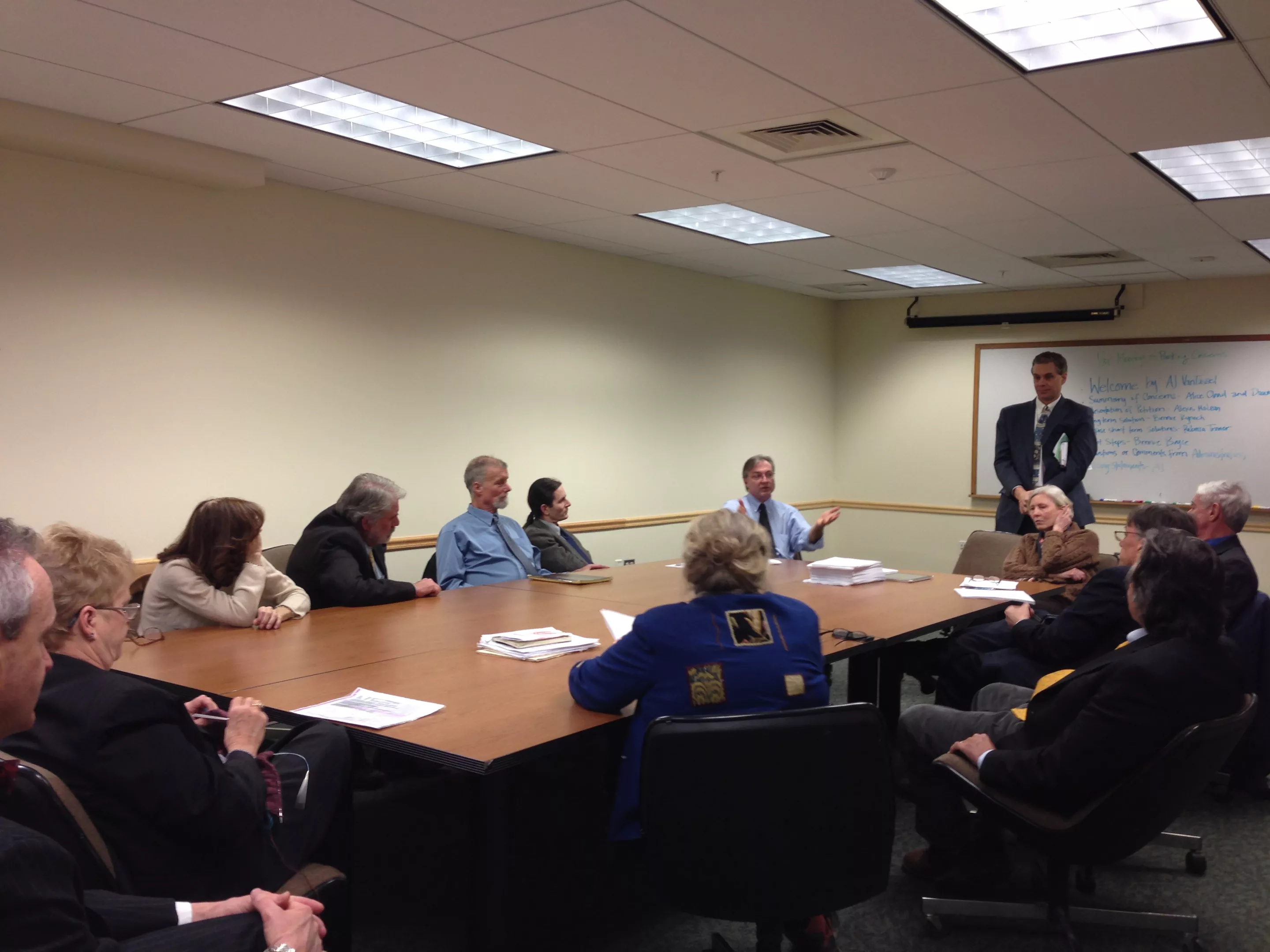
Their goal was to resolve internal differences privately before a long-stalled campaign finance bill reemerges on the Senate floor Friday. But as Senate Democrats and Progressives met Thursday afternoon in a basement conference room near the Statehouse, a pitched debate erupted instead.
With tempers flaring over matters both philosophical and procedural, the group of 18 senators had to call in Senate Secretary John Bloomer (pictured standing at right) to explain how they should revisit legislation pulled abruptly from the floor late last month.
The crux of the issue is this: Two weeks ago, the Senate voted 21-8 to amend a comprehensive campaign finance bill to bar direct corporate contributions to political candidates. But before that and another amendment could be fully attached to the underlying bill, Senate President Pro Tem John Campbell (D-Windsor) ordered it to lie.
In other words, he sent it to legislative purgatory.
In the weeks since, Campbell and the bill's author, Sen. Jeanette White (D-Windham) have been working behind the scenes to tweak it in order to resolve a bevy of concerns raised during the floor debate. As VTDigger's Nat Rudarakanchana reported earlier this week, those changes were incorporated into a substitute version of the bill, which was approved Tuesday by the Senate Government Operations Committee.
Oddly, though, despite the fact that more than two-thirds of the Senate had voted in favor of banning corporate contributions, the committee stripped that particular provision from its substitute bill.
That had supporters of the ban fuming at Thursday's meeting. Chief among them was Sen. Peter Galbraith (D-Windham), who wrote the corporate contribution amendment.
Shortly before the U.S. Senate voted to debate a polarizing gun-control bill Thursday morning, Sen. Patrick Leahy (D-Vt.) delivered an impassioned plea to his colleagues to "stand up and be counted."
In a 10-minute speech on the Senate floor, Leahy repeated that refrain over and over again, appearing as if he was seeking to shame his fellow senators into voting on the legislation, regardless of where they stood.
"Stand up and be counted! Stand up and be counted!" he said, nearly shouting. "Don't give speeches saying you're in favor of law enforcement, but we're going to take away the tools law enforcement needs. Stand up and be counted. Stand up and be counted."
Calling Republican efforts to stall debate an "ill-conceived filibuster," Leahy said, "Americans across this great country are looking to us for solutions and action, not filibustering or sloganeering. Americans are saying, 'Stand up and be counted.'"
Watch the full video here:
Not long after Leahy's speech, the Senate voted 68 to 31 in favor of taking up the legislation. The bill includes several provisions passed out of the Senate Judiciary Committee, which Leahy chairs, including a measure the Vermont senator wrote that cracks down on gun traffickers and "straw" purchasers.
The legislation received a major boost earlier this week when Sens. Joe Manchin (D-W.Va.) and Patrick Toomey (R-Pa.) signed off on a bipartisan plan to extend background checks to unlicensed firearms dealers. The bill does not include more controversial proposals, such as a ban on assault weapons and high-capacity ammunition, though such measures will likely reappear in the form of amendments on the floor next week.
The others who voted in favor of debating the bill were Sen. Bernie Sanders (I-Vt.), 49 other Democrats, 16 Republicans and another independent. Two Democrats and 29 Republicans opposed ending the filibuster.
Tags: Senator , Bernie Sanders , Video , Web Only
Thursday, April 11, 2013
In this week's issue of Seven Days...
- On the cover: Vermont ACLU director Allen Gilbert is sounding the alarm about government intrusion. Is anyone listening?
- A small elementary school near the Canadian border bucks the achievement gap trend. What can other districts learn from the success of Montgomery's impoverished students?
- Rolling Stone reporter Matt Taibbi has issued several scathing reports on the perilous state of the financial industry. He's in Burlington for a town meeting event on too-big-to-fail banks with Sen. Bernie Sanders on Friday night.
- A bill in the House would offer Vermont student athletes greater protections from the effects of head injuries.
- Gun control efforts are dead at the state level, but Burlington isn't backing down from its push to ban assault rifles and high-capacity ammunition clips. Mayor Miro Weinberger even appeared in a PSA with other pro-gun control mayors.
- In Fair Game: Senate Democrats are regularly meeting outside the Statehouse in secret. Innocent strategy sessions, or violations of Vermont's open-meeting law?
Read these stories and more in print, online or on the Seven Days app.
Tags: Senator , Bernie Sanders , Web Only