

Tuesday, December 7, 2021

Tags: William Metcalfe , Vermont Mozart Festival , University of Vermont , Oriana Singers , Web Only , Image
Tuesday, July 30, 2019
After a deep exhale, the 27-year-old native of Mexico played Bach’s first “Goldberg Variation” as if he believed it to be the most beautiful piece ever composed. As indeed it was, in his hands.
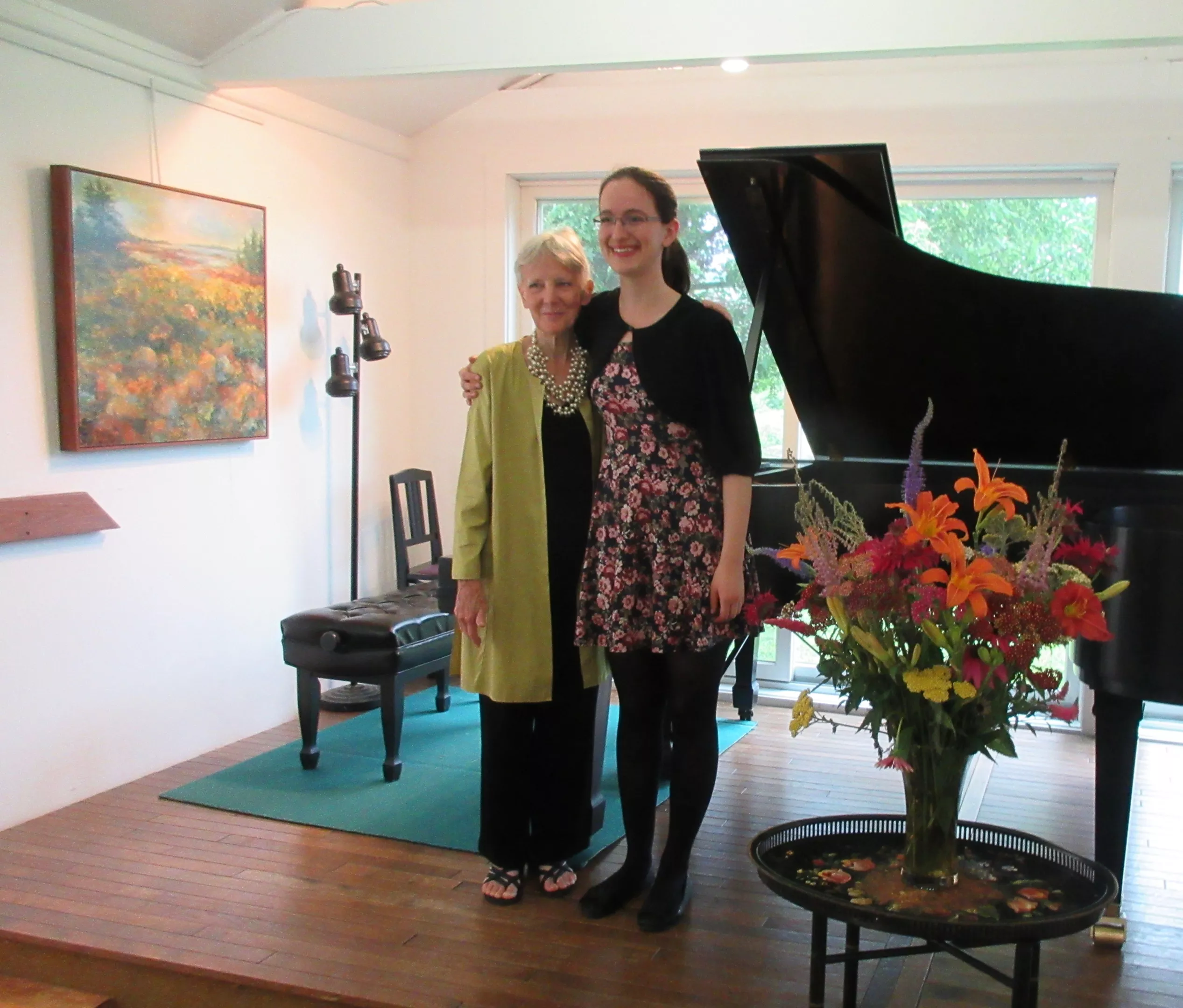
Despite its generalized name, Adamant Music School is solely for pianists. It has been helping them hone their skills for 77 years — ever since cofounder Edwine Behre chose the tiny rural hamlet as a summer respite for her New York City students.
Tags: Adamant Music School , pianists , Vermont , Web Only , Image
Monday, February 24, 2014
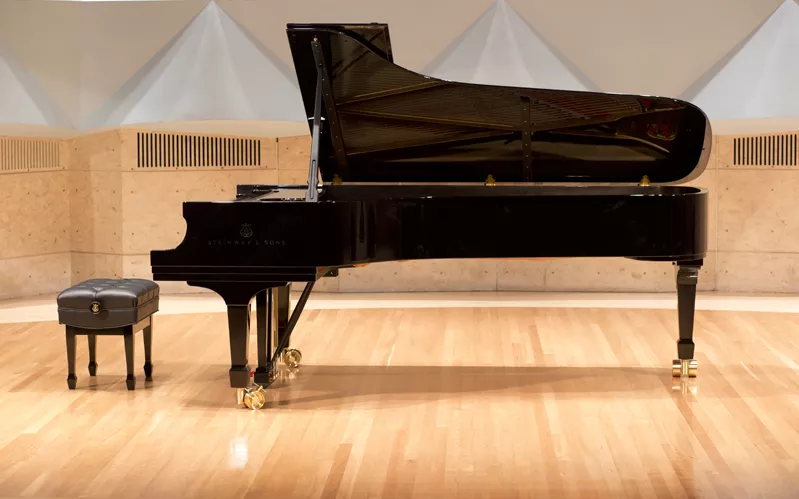
The coming years at Middlebury College promises even greater euphony thanks to a brand-new Steinway. The grand is renowned as the piano of choice in concert halls around the world, and Midd recently became home to one of them. It is a gift of the Meredith, Ray and Nathaniel ('12.5) Rothrock family in honor of President Ron Liebowitz and his wife, Jessica Liebowitz.
Here are some fun facts: The piano has 12,000 parts. It is nine feet long and weighs 990 pounds. Steinway grands are painstakingly manufactured in a process that takes nearly a year to complete.
“It’s thrilling to see this instrument rolled out on our stage for the first time,” says Allison Coyne Carroll, associate director of the performing arts series at Middlebury, in a press release. “This piano is a wonderful addition to our concert hall, and its quality will be a joy for performers and audiences alike.”
Steinway artists and concert soloists Richard Goode and Paul Lewis, Middlebury faculty member Diana Fanning ’71, and Middlebury alumna Gwendolyn Toth ’77, traveled to the Steinway factory in Queens, N.Y., in late October 2013. They tested five pianos chosen to suit the acoustics of the Mahaney Center concert hall. Luckily for the world-renowned pianists who appear there, as well as listeners, a concert grand was the top choice.
The college celebrates its new, glossy-black Steinway on Saturday, March 1, with a lecture and concert. Guest Joseph Polisi, president of the Juilliard School, kicks off the event with a talk titled "The Arts, Education and the Human Experience" at 4:30 p.m. in the Mahaney Center concert hall. Polisi was awarded an honorary Doctor of Arts degree from Middlebury in 2010.
Tags: Middlebury College , steinway concert grand , piano , performing arts , Image , Web Only
Sunday, February 23, 2014

I had intended to drive northward today for a taste of the mega-event called Montréal en Lumière But, dommage, both of my traveling companions begged off. And since I didn't want to go alone, this is what I am missing. A gigantic Ferris wheel, right in the middle of St. Catherine Street.
I have an inexplicable love of Ferris wheels. The one pictured here, courtesy of Air France, only looks this way at night, of course. But day or night, what a great view from its top! Well, maybe later this week.
Montréal en Lumière offers way more than a colorful carnival ride, to be sure. There's also something called an "interactive urban super-slide," and scattered around the Place des Festivals are promised "wow" moments from various special effects, including a "cube" that uses lasers, smoke and lighting to produce "multidimensional" hallucinations. Or something like that. I'm wowed just thinking about it. Three-story projections and other light-related stimuli justify the festival's name — and these are all part of the free outdoor site.
Tags: montreal en lumiere , nuit blanche , festival , canada , Image , Web Only
Monday, February 17, 2014

Everybody knows you're not supposed to yell "fire" in a crowded theater unless the theater is filling with smoke.
But apparently there are still people out there who think it's OK to yell "hello" in a crowded theater. Into a cellphone. During a concert.
I saw Kronos Quartet at the Flynn Center for the Performing Arts on Saturday night and have been outraged ever since. I've just got to vent.
No, I'm not outraged about Kronos, whose playing was exquisite, as always. Their program was on the esoteric side — what some listeners might call "challenging" — but really, really powerful and moving, IMHO.
On the bill — the second half of the concert — was "Black Angels." That's the piece that inspired violinist David Harrington to form Kronos when he heard it for the first time in 1973. If you've never heard it, there are many moments of extreme quiet — almost inaudible music. All the more reason the audience was almost holding its collective breath, trying not to interrupt with the noise of inhaling and exhaling.
And that's when the cellphone rang. It was in the purse of a lady in the row right behind me. After she rummaged around for it for several painful seconds, everyone who had turned to glare at her assumed she would then silence it, duly chastised for forgetting to turn it off.
But no.
Tags: Kronos Quartet , Flynn Center for the Performing Arts , Black Angels , string quartet , cellphone , Image , Web Only
Thursday, February 13, 2014

Last week I downloaded a free concert of works for piano and cello by Mendelssohn and Brahms from Vermont Public Radio. The “Beyond Beethoven” cycle of two cello sonatas by each post-Beethoven composer, performed by pianist David Kaplan and cellist Ben Capps, now lives on my laptop, where I will play it again as a reward for finishing this blog post.
Whether you pay for online streaming services, such as Spotify, or order CDs by mail (a way of listening to music that seems to have found its last surviving market among classical fans), a free download is a free download. It’s easy to do, and you have until February 28. Go to vpr.net/apps/beyond-beethoven, and click on the tiny word “download” at the corner of each of the four pieces. If you miss the window to own them, you can listen to them online at VPR’s website.
“Beyond Beethoven” is Kaplan and Capps' second free-download collaboration, following last year’s “The Beethoven Project.” For that, the duo played all five cello sonatas by the composer, who gifted the form with an equal balance among instrument parts. (Before Beethoven, what we now call “cello sonatas” were often piano pieces with a cello doubling the bass line.) Of that project, sonatas 2, 4 and 6 have been made available again for free download through April.
This is all treat enough, but last Friday, VPR invited donors and media to a live concert by Kaplan and Capps, who played excerpts from and discussed the works they chose for “Beyond Beethoven.” VPR Classical host Joe Goetz, who produced the recordings, introduced the duo. The concert took place in the same intimate recording studio where the downloads were recorded, the space’s large red digital clock ticking away the microseconds. Kaplan and Capps were not paid for their work, and they won’t earn anything from it; it’s a gift.
Tags: classical music , Vermont Public Radio , Joe Goetz , Ben Capps , David Kaplan , "Beyond Beethoven" , downloads , Image , Web Only
Monday, November 11, 2013
While it's not exactly incorrect to refer to the music of ETHEL as classical, it would surely miss much of the point. The genre-defying, restlessly inventive string quartet brings its new program, "Grace," to UVM's Lane Series on Friday, November 15.
Cofounding member and violist Ralph Farris spoke via phone to Seven Days about the band's creative process, different kinds of grace and the enduring greatness of Rush.
SEVEN DAYS: Why is your name in all caps, anyway?
RALPH FARRIS: Why not? I don’t have a good answer! It showed up in a graphic we did once, and it stuck. The name doesn’t stand for anything, and means nothing. There’s really no good reason, which is a terrible answer for you.
So you used to be the musical director for Roger Daltrey. What does that mean, exactly?
It was a quick little run, in 1994. I was the guy who went to each city in advance of a touring concert with the Roger Daltrey Band, who were playing with orchestra, playing the music of Pete Townshend. I would train up the orchestra playing with him, but I really was the assistant conductor. The conductor would show up after me and conduct the show, and I would then be the fiddle soloist for the band. I would play “Baba O’Reilly” all summer. Really cool gig.
Monday, June 24, 2013
It's a good week to be an organ lover in Vermont. I'm not talking organ meat — though there's plenty of that to be had these days as well.
No, I'm talking about the National Convention of the Organ Historical Society, which begins today in Burlington. It's attracted more than 300 enthusiasts from all over the U.S. and even abroad, according to convention chair Marilyn Polson of Chelsea, who plays a 119-year-old historic instrument at the Bethany Church. The OHS, she explained, was founded in 1956 by people who wanted to raise awareness of and protect/restore 19th-century pipe organs.
It seems that in the 1950s, a craze for playing Baroque music resulted in some of the instruments being altered in ways that I can't explain — something to do with high-pitched stops. In a phone conversation, Polson was indulgent of my organ ignorance, but was firm in her assertion that "19th-century pipe organs are so listener-friendly!"
In addition to intentional alterations, she said, many organs at churches have simply suffered from "benign neglect," as maintenance and repairs are likely not in the general budget.
The five-day convention will give participants plenty of opportunities to geek out ("We love to talk organ," Polson quipped), including day trips on tour buses to rural churches in 14 central and northern Vermont towns that have exceptional examples of said instruments. Those are Randolph, Williamsburg, Northfield, Montpelier, Stowe, Hardwick, Greensboro, Cabot, Plainfield, St. Albans, Highgate Falls, Vergennes, Richmond and Sheldon.
Wednesday, June 5, 2013
Good things come in threes, it's said. Bad things do, too, but never mind. The Green Mountain Monteverdi Ensemble of Vermont (pictured here) cheekily goes for triple redundancy in its name — can you spot them? — and for a trio of performances this week around the state. But in its program, GMMEV goes for pairs.
That is, pairs of composers of Baroque-era sacred choral and vocal music who set the same text to different music. "Double-Takes" includes in most cases one setting for a duet or other small ensemble and another for a larger group, director Stephen Falbel explains. He promises it will "make for a fascinating evening of juxtapositions of styles and ensembles."
On that program are three motets by Johann Sebastian Bach and works by Schütz, Schein, Scheidt, Franck and Johann Christoph Bach — cousin of the more famous Bach.
"Double-Takes" features eight singers, many of whom have performed with Vermont's esteemed professional vocal ensemble Counterpoint: sopranos Lindsey Warren and Cathleen Stadecker; altos Carolyn Dickinson and Linda Radtke; tenors Adam Hall and Paul Reynolds (replaced by Counterpoint director Nathaniel Lew in the Burlington concert); and basses Falbel and Brett Murphy.