

Thursday, February 4, 2021

Steven Gayle, a senior director at the White River Junction research and analytics firm Resource Systems Group, which contracts with the Agency of Transportation, had been scheduled to testify about a study on direct-to-consumer vehicle sales.
Gayle popped up on screen during a 10-minute break in the Senate Transportation Committee's live streamed meeting and shortly after could be seen wringing his hands, gritting his teeth and whispering to himself, seemingly unaware his microphone was on.
"Don't believe this shit," he said at one point. "They'll say anything to get elected." He later said, "Yeah, we arrested every nigger," before repeating the slur again shortly after.
The meeting was reconvened a few minutes later and Gayle's comments were never addressed. But video of the incident later circulated among legislators, eventually rising to the attention of Senate President Pro Tempore Becca Balint (D-Windham), who issued a statement Thursday morning saying she was "deeply troubled" by it.
Tags: Steven Gayle , Resource Systems Group , Vermont , Racial Slur , Web Only , Image
Friday, January 29, 2021

A Senate committee voted unanimously Friday to reject Gov. Phil Scott’s executive order to reform the administration of Act 250 following scathing testimony from one witness about the governor's motives.
Scott’s January 14 order sought to streamline the administration of the land-use law by creating a statewide board to decide major projects, taking the place of the nine district commissions that do so now.
The Senate Natural Resources & Energy Committee voted 5-0 to block the order, setting up a vote by the full Senate next week.
Sen. Mark MacDonald (D-Orange) said he was surprised the Scott administration had pushed to reform the law through executive fiat, lamenting the governor’s “take or leave it” approach.
“I would vote to leave it, and hope that the next time the governor proposes an executive order it’s because a consensus has been reached,” MacDonald said.
Scott's spokesperson, Jason Maulucci, asked how many
"The Administration's position on the Governor's initiative itself is that we appreciate the Legislature's willingness to continue this important discussion and we hope to convince them of the merits of the proposal," Maulucci said in a statement.
The Senate committee passed a resolution that presumes only one chamber of the General Assembly needs to reject the order to block it, which is a point of legal contention. Scott claims rejection by both chambers of the General Assembly would be required to block his order, though that’s not how state law reads.
He argues the state law unconstitutionally limits his executive authority and federal caselaw backs him up. The Senate resolution sidesteps that constitutional argument.
Even Sen. Richard Westman (R-Lamoille) voted to reject his fellow Republican's executive order. He stressed that he hoped lawmakers would solicit a wider range of testimony on Act 250 in the future.
“There are a lot of people who would like to testify on this issue,” Westman said, “way beyond the number that we have had in.”
The highlight of the morning’s testimony was Ed Stanak, a Barre Progressive and longtime Act 250 district coordinator, who said Scott’s reform efforts were misguided. He noted that Scott’s objections to the law stem from Scott's attempt to open a motorcycle shop in Morrisville 40 years ago.
“Scott claims that unreasonable delays in obtaining an Act 250 permit subsequently forced him to abandon his business proposal, and he has been hellbent on reforming Act 250 ever since,” Stanak said.
In fact, the record from 1983 shows Scott’s development partner started construction without permits, never completed the Act 250 review and withdrew the application four years later. Scott has since used this “tale of woe” in stump speeches and has publicly said the failed project changed his life, Stanak testified.
“The misplaced bitterness of a young businessman became a pillar upon which a political career has been built, and continues to this day,” Stanak said.
Scott's executive order would destroy the time-tested Act 250 district commission process through “brazen political power” based on Scott’s “imagined understanding of the Act 250 process."
Scott has argued that a more professional, consolidated permit process would provide developers with a more predictable, less expensive and protracted review process that still protects the environment.
Julie Moore, the secretary of the Agency of Natural Resources and the administration’s chief advocate for Act 250 reform, said she was disappointed by the committee’s action.
“The remote environment we are all working in is clearly challenging, and made harder when legislative committees are unable to provide a complete picture of their days’ planned work,” Moore said.
She declined to comment on Stanak's charaterizations.
Sen. Chris Bray (D-Addison), said while Stanak’s "personal interpretations" of the governor's thinking made him “a little uncomfortable,” he praised his committee for “handling a sensitive matter with finesse.”
Tags: Act 250 , Phil Scott , executive order , Senate , Web Only , Image
Tuesday, January 26, 2021

Updated at 7:48 p.m.
Gov. Phil Scott on Tuesday outlined his $6.8 billion budget proposal for the coming year, noting in his annual address to the general assembly that the state was sitting on an unexpected $210 million surplus.
The rosy budget picture, buoyed by federal COVID-19 relief funds, was in stark contrast with dire predictions made earlier last year of a major deficit. But Scott, a Republican, urged lawmakers to spend the one-time windfall wisely and to avoid the temptation to expand programs the state may be unable to afford once the infusion of federal relief funds dries up.
The governor told legislators to seize the surplus to invest in broadband and schools, build new housing and revitalize downtowns, and pursue other initiatives to put the state on better economic footing to recover from the pandemic.
Tags: budget , COVID-19 , Phil Scott , governor , Vermont , Web Only , Image
Friday, January 22, 2021

Till, a practicing physician, told Seven Days on Friday that he found it "disturbing" to see how many people "suddenly found religion" after Vermont became the first state in the nation to remove its "philosophical exemption" five years ago, a move he strongly supported.
A study published in late 2019 found that while the number of Vermont kindergarteners who avoided vaccinations for non-medical reasons dropped from 5.7 percent to 3.7 percent in the two years after the policy change, the rate of religious exemption claims jumped from 0.5 percent to 3.7 percent.
"The truth of it is that there are very few religions that actually have an objection to [vaccines]," Till said. "People were really, truthfully just misusing the religious exemption."
Tags: Vaccinations , George Till , Legislature , Web Only , Image
Thursday, January 21, 2021
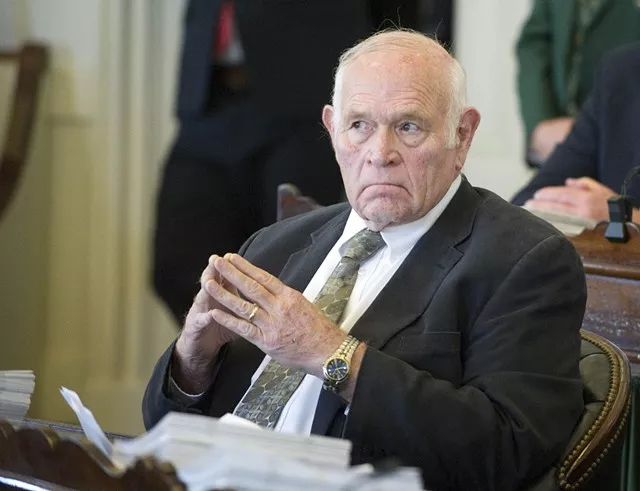
"When Montgomery ended Laura’s life, he forever changed my life, my husband’s, her sister’s, and her brother’s," JoAnn Winterbottom told the Vermont Senate Judiciary Committee on Thursday, testifying alongside her husband, Ned. "We, in fact, are serving a relentlessly painful lifetime sentence. Allowing him to qualify for an earlier release is not acceptable to us, and it is certainly not in the interest or pursuit of fairness and accountability."
Tags: Prison , 'Good Time' , Laura Winterbottom , Dick Sears , Web Only , Image

Scott issued an executive order last week shifting power from the nine volunteer district commissions that administer Act 250’s development regulations to a single, professional statewide board.
“We can and must protect our environment and support regional economic development reliant on vibrant downtowns and village centers,” Scott said in a press release. “That’s our focus in this work, because we cannot achieve these goals with the outdated and cumbersome administrative structure we have today.”
Passed in 1970 in response to unchecked growth that followed completion of interstate highways, Act 250 established statewide standards even while setting up district commissions to retain local control. Today, critics contend that the decentralized model creates inconsistency in its administration and duplication of effort when local decisions on large projects are inevitably appealed.
Tags: Act 250 , Phil Scott , environment , district commissions , Web Only , Image
Tuesday, January 19, 2021

"This means they can, if they choose, mail ballots to all registered voters in place of more traditional town meetings, or the typical in-person elections used by many cities and towns," Scott said at a press briefing.
The bill, H.48, seeks to keep residents safe during the coronavirus pandemic by offering flexibility ahead of Vermont's traditional March voting day. It will empower municipalities and school districts to send out ballots in a system similar to the one used during Vermont's first-ever mail-in election in November.
Tags: Gov. Phil Scott , Town Meeting Day , Elections , Votes , Mail-In Voting , Web Only , Image
Sunday, January 17, 2021

Noon came and went at the snowy Vermont Statehouse with no armed protesters in sight, leaving little for the assembled journalists to document beyond heavily-armed state troopers on foot patrol and a guy with a handwritten badge that read "Anti-Fascist Riot Prevention Volunteer," whose head was encased in a gas mask that looked like it might have seen duty in a world war.
“I’m wearing it just in case,” said Montpelier resident Thomas Gram, who added that the device served the dual purpose of protection against COVID-19 and any tear gas he might encounter.
Gram and Belynda Jestice of Plainfield had wandered down to the Statehouse from a group of counter-protesters in front of Montpelier City Hall. Jestice said she was relieved that there was no armed protest to counter.
“We wanted to send the message that they can’t come here and do what happened in D.C.,” Jestice said.
Tags: protest , Montpelier , Web Only , Image , Slideshow
Friday, January 15, 2021
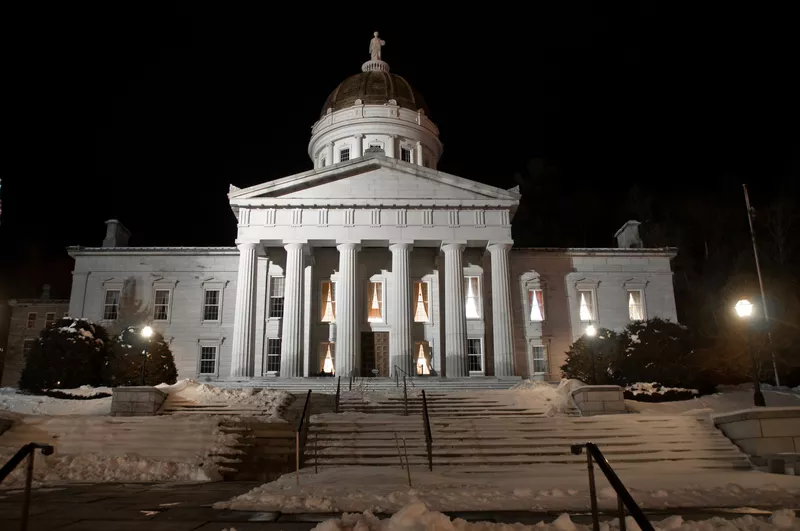
Public officials, police, and Vermont's Republican and Democratic parties are urging caution ahead of what law enforcement authorities have called possible plans for armed protests at the Vermont Statehouse.
The potential threat prompted the Montpelier City Council on Wednesday to pass a resolution recommending the closure of schools, the Statehouse and city hall on January 20, the date president-elect Joe Biden is sworn in. And on Friday, the Vermont Judiciary announced it would cancel all in-person hearings and meetings scheduled for Tuesday and Wednesday.
The Federal Bureau of Investigation has warned local law enforcement in all 50 states about potential threats by armed pro-Trump extremists who falsely claim that President Donald Trump won reelection in November.
Trump supporters stormed the U.S. Capitol on January 6, an insurrection that led to the killing of a police officer and four other deaths.
Law enforcement officials have flagged Sunday, January 17, and Wednesday, January 20, as two dates of potential armed protest.
The Montpelier resolution calls for “residents and visitors to make the safe choice and refrain from direct in-person counter-protest activity due to the risk of violence.
“There are other ways, safer ways to make your voice heard and to stand up for what you believe in,” the resolution reads. “We’re asking you to consider safety first during these events. In addition, there is neither need nor necessity to be armed at a peaceful protest, and anyone coming to any of these events, please do so without firearms.”
Tags: Montpelier , Statehouse , protest , guns , Web Only , Image
Thursday, January 14, 2021

Applicant names are considered confidential under Act 164, the law passed last year that legalized recreational cannabis sales in Vermont starting in 2022. But Gov. Phil Scott’s office, which is overseeing the application process, released some demographic information about the 94 people who applied during a two-week period in December:
- 57 identify as men and 30 as women; seven did not disclose.
- 72 identify as white; two as Black/Hispanic; two as Native American; one as Hispanic; three as Black, Indigenous, other people of color/mixed race; and 14 did not disclose.
- 77 applicants are from Vermont, while 17 live out of state.
The governor ultimately appoints the three board members, but a seven-member Cannabis Control Board Nominating Committee first vets the applicants. By statute, two lawmakers each from the House and Senate serve on the nominating committee. They are Rep. Janet Ancel (D-Calais), Rep. John Gannon (D-Wilmington), Sen. Jeanette White (D-Windham) and Sen. Chris Pearson (P/D-Chittenden).
Under the law, the governor chooses three others “from the Executive Branch.” He picked Anson Tebbetts, secretary of the Agency of Agriculture, Food and Markets; Nicholas Lopez, an attorney with the state Department of Human Resources; and Sabina Haskell, a Burlington woman who is director of public affairs at the Vermont Student Assistance Corporation. A former journalist who also previously worked at the Agency of Natural Resources, Haskell now serves on the state Department of Liquor and Lottery board.
That board work qualified her to serve on the nominating committee, according to Jason Maulucci, a spokesperson for Scott.
“The three individuals appointed [to] the Nominating Committee were selected because of their experience and its relation to the work of [the] Cannabis Control Board,” Maulucci said in an email. “Like many of these boards and commissions, there was not a formal application process — the appointees were identified and asked to serve because of their backgrounds.”
Haskell said someone from the governor’s administration contacted her in late November about serving on the nominating board.
“Everywhere I’ve lived, I’ve held some kind of office — on the school board, or I was on the Burlington Electric Commission — and those kinds of things are really important to me,” she said. “It’s a way I give back.”
Haskell’s son, Ethan Latour, is a former top aide to Scott and was recently named deputy commissioner of the Department of Finance & Management. Asked about the family connection, Haskell said she and her son have a “firewall” and don’t talk shop.
“I am purposeful about that, because of the optics; it’s awkward,” she said. “The only time I knew something ahead of time was when he found out he was going to be deputy commissioner. And I thought that was OK, because I am his mom.”
Haskell said the committee has an organizing meeting on Monday. They’ll have their hands full, with dozens of applicants to wade through. The committee will send applicants considered “well-qualified” to the governor.
Once hired, the Cannabis Control Board members will be full-time state employees. The chair will serve three years and earn an annual salary of about $107,000. One member will serve two years and the other one year. Those members will each make about $80,400 annually. The board will hire an executive director, administrative assistant and will have a $650,000 budget during the current fiscal year.
The process for creating the board is already behind schedule. By law, Scott was supposed to have named his picks by January 8, with Senate confirmation on or before January 15; their terms were to begin on January 19.
Instead, the vetting of applicants is only just beginning.
Sen. Pearson, the nominating committee member, said the delays were understandable, especially given the pandemic. He didn’t think the lag would have an impact on other, later dates in the process. The law, for instance, calls for the control board to recommend certain fees by April 1, and to begin making rules for cannabis establishments by June 1.
The first licensees could begin legally selling weed in May 2022 — if all goes according to plan.
“This is the beginning of what is quite a long process,” Pearson said. “Being a few weeks behind, to my mind, is not the end of the world. We can catch up. I think we have a decent structure and once the board is up and running, I’m sure they’ll take it seriously and presumably be able to make up for some of the lost time.”
Tags: cannabeat , Cannabis Control Board , Phil Scott , Web Only , Image