

Thursday, February 7, 2013
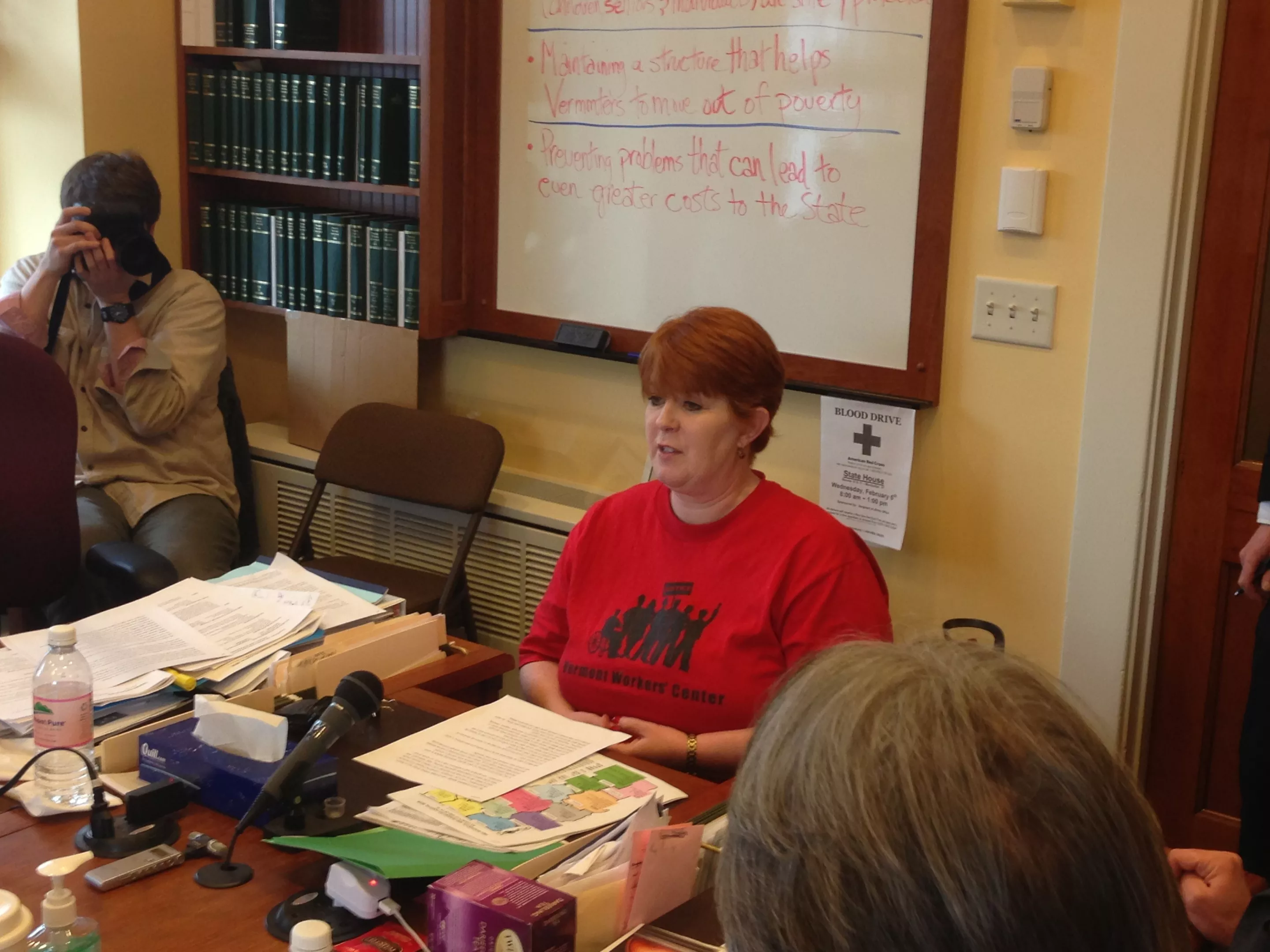
A group of eight unemployed St. Johnsbury residents sought to humanize a looming budget battle at the Statehouse Wednesday, sharing stories about the difficulty they've found trying to move from state assistance to full employment.
Mostly single mothers, the women urged legislators to reject Gov. Peter Shumlin's proposed $6 million cut to the Reach Up welfare program, calling it an essential lifeline when they're out of work.
In his budget address last month, Shumlin called for Reach Up benefits to be capped at three consecutive — and five total — years, arguing, "Extending welfare to work benefits without interruption for a lifetime does nothing to actually encourage people to get a job."
But Martha Aguila (pictured above), an unemployed, single mother of four from St. Johnsbury, took issue with those words Wednesday.
"To us, [Shumlin] makes it sound like people are staying on Reach Up because it's easier or better than having a job," she told the House Human Services Committee.
That's hardly the case, she said. Of the $680 she receives each month through Reach Up, $550 goes straight to rent. That leaves her with $130 to cover the remaining expenses that she and her children face.
Wednesday, February 6, 2013
This week's Seven Days is the annual love and marriage issue. (That's the Pinterest-inspired cover over on the right.) Rest assured that despite the wedding bells, this week's news and politics stories are as contentious as ever.
- The State Police Advisory Commission exists to hold state law enforcement accountable. Critics say it's failing in its mission.
- One gun control measure in the Statehouse already sputtered out this year, but here comes a new one, tackling high-capacity ammo clips, background checks and more. Does it stand a chance of passing?
- New details have been revealed in the 2011 case of a prostitution ring for migrant farmworkers — including new customers and co-conspirators.
- In Fair Game: Gov. Peter Shumlin stands by his much-maligned plan for new childcare subsidies. Plus, more global trips for the governor, the Legislature takes on the F-35 and a former Massachusetts governor settles down in Vermont (not the one that just ran for president).
Lastly, one more reminder that if you've got an iPad or iPhone, you can get all the page-flipping satisfaction and pretty layouts of the print edition with our new app. Click here to download it.
Tuesday, February 5, 2013
Chittenden County State's Attorney T.J. Donovan says he's dropped a short-lived inquiry into a five-year-old allegation of sexual assault in the Vermont National Guard.
Donovan's investigation stemmed from an anonymous letter that prompted a candidate for adjutant general to exit the ongoing race to lead the Vermont National Guard last week. The author of the letter wrote that she had been sexually assaulted by a senior Guard officer in December 2007 and claimed that Jonathan Farnham and another senior officer failed to report it to civilian law enforcement officials.
After Seven Days wrote about the episode, Donovan said last week that he hoped to contact the victim to determine whether she could provide more information about the alleged perpetrator — and whether she would cooperate with an investigation.
Donovan says he spoke to the woman over the weekend and found that she was not interested in revisiting the episode further.
"We had a good talk. While I think that a crime was most likely committed five and a half years ago, the victim expressed to me her desire not to go forward with any criminal prosecution," Donovan says. "Given that, we will not go forward."
Her unwillingness to cooperate, Donovan says, "would render an investigation extremely difficult to prove any allegation" — even if he were to subpoena records from the Vermont Guard of its own internal investigation of the incident.
"Even if you were able to get some information, you would still need real, live testimony from a victim at trial, because you'd be dealing with essentially hearsay if you were relying just on documents," he says.
Is Donovan concerned that the alleged perpetrator remains free and may still be serving in the Guard?
"My sense is, given the recent publicity of what occurred in the last few weeks, this individual knows who he is, and this publicity will likely be the best deterrent in him engaging in any future conduct."
Monday, February 4, 2013
Last week Seven Days followed up a story we first explored back in December: When shelters are full, the state turns to local motels to house homeless families and individuals. The practice is on the rise after the state loosened eligibility requirements in 2009, and it's costing taxpayers a pretty penny — more than $2.2 million in fiscal year 2012, and likely more still this year.
As we reported last week, a few local motels are profiting mightily from the extra business (total earnings for top motels in fiscal year 2012 pictured at right).
What we couldn't uncover in time for the print edition was specific information about just what kind of rates the state is negotiating with these motels. Vermont Department of Children and Families deputy commissioner Richard Giddings told us the state's antiquated computer system made it impossible to quickly generate reports pinpointing nightly rates at the various motels.
So we filed a public records request, asking for billing information from six of the highest earning motels in fiscal year 2012. How much did these motels bill the state during the months of November and December, and more importantly, what sort of nightly rates did the state negotiate? How does this spending compare with the cost of traditional homeless shelters?
In some cases, the state is securing lower rates than other motel customers, according to the documents. At the University Inn, where Vermont taxpayers paid for 1312 nightly stays in November and December, the state negotiated a rate of $38 a night — a roughly 34 percent discount from the flat rate of $54 that the South Burlington motel typically charges at this time of year.
The Ho Hum Motel on Williston Road in South Burlington quoted this reporter rates of $68 and $78 a night for a single or double room, but charged the state $42 in November and December. The Swiss Host billed out at $39 a night, but quoted rates by phone ranging from $66 for a night's stay to $47 a night at the weekly rate.
But discounts vary by motel. Documents provided by DCF show the state paid $60 a night at Rutland's Economy Inn, to the cumulative tune of $39,060 over two months; a receptionist at the motel quoted the same rate by phone when we called this week. Similarly, the Econo Lodge in Shelburne charged $50 a night for state-funded clients, and a search of its rates online turned up a "best available rate" that is essentially identical: $49 a night.
Of the six motels included in our public-records request, America's Best Inn in Brattleboro earned the most in taxpayers' dollars in November and December: Charging between $55 and $70 a night, the inn billed the state for $60,136 during those two months.
The records also show that, for many of these motels, visitors on state assistance make up a huge chunk of their potential business. The University Inn housed, on average, 22 clients a night in November and December; with 88 rooms available, those clients would account for a quarter of the motel's business if all rooms were filled. And even if some of these hotels are cutting the state a deal, the total amount spent during just two months last year is still staggering: $240,017 between the six motels alone.
How do the rates stack up against the costs faced by nonprofits serving the homeless population? Mark Redmond, the executive director of Spectrum Youth & Family Services in Burlington, says that his organization is contracted to bill the state $65 a night when DCF asks Spectrum to shelter an individual. But that $65 buys far more than a warm bed, says Redmond: Spectrum's services include case managers who help residents craft plans about health care, schooling and life skills. There is an overnight supervisor awake all night long in each of Spectrum's facilities. Spectrum provides access to a health clinic, job training and mental health or addiction counseling services.
In other words?
"It's like the total package. It's not just the roof over your head," says Redmond. "Frankly, it’s the solution. I think what we provide is the way out of homelessness."
Burlington's Committee on Temporary Shelter (COTS) doesn't track spending on a per-night basis, but director Rita Markley did pass along some of the expenses the organization shoulders; they vary, she explains, depending on the type of shelter and services provided.
For instance, COTS spent $113,700 running a temporary overflow shelter for homeless individuals between October 2011 and July 2012; if the shelter were constantly at full capacity (18 individuals), the costs break down to roughly $21 a night per head. At COTS' waystation, which typically shelters 36 individuals, the cost breaks down to roughly $16 a night if fully occupied.
Political gamesmanship is common at the Statehouse, but on Wednesday, legislators played games of a different kind. That afternoon, a group of local video game developers set up their iPads and gaming consoles in Room 11, and invited lawmakers to stop by and play.
It took some convincing — more than one onlooker muttered comments along the lines of "I don't play these things but my kids and grandkids do" — but eventually some of them got in the game.
Montpelier Mayor John Hollar took a turn at Swamp Talk, a word game developed by Montpelier-based programmer Chris Hancock. Sen. Anthony Pollina (P/D-Washington) learned the finer points of Overflow from Zach Bohn of Birnam Wood Studios. And Montpelier voice-over artist Jackie Weyrauch convinced Treasurer Beth Pearce to try Ratchet & Clank Future: Tools of Destruction, a console game Weyrauch worked on with Insomniac Games.
Organizers of the pop-up Statehouse arcade included members of the Vermont Video Game Developers' Association, along with students and faculty from Champlain College and representatives from the Central Vermont Economic Development Corporation. They hoped to raise the profile of the local gaming scene and convince lawmakers to support it.
The $52 billion-a-year industry presents a big economic opportunity for Vermont, these advocates claimed in a press conference in the Cedar Creek Room earlier in the day. Pollina kicked off that gathering. He told reporters that the video game industry provides "clean jobs" that appeal to young workers. He wants the state to do more to attract those workers here.
"The way we market our ski areas is the way we should be marketing our digital economy," Pollina said.
Here's what's happening in Vermont news and politics this week. Got a newsworthy event for next week's calendar? Email by Friday to submit.
Monday, February 4
- At 7:10, Gov. Peter Shumlin is the guest on "Charlie, Ernie and Lisa" on WVMT 620 AM.
- At 11 a.m., Gov. Shumlin drops by the Trinity Children's Center in Burlington for a press conference on his calls for more early childhood education funding. Then at noon, the guv speaks to the Burlington Rotary Club's conference at the Hilton. And presumably plays some break-open tickets.
- Also at 11 a.m., Channel 17 airs its live state politics call-in show "Conversations With Your Legislators." On the hot seat for week two: Rep. Linda Waite-Simpson (D-Essex Junction) — the sponsor of a new gun-control bill in the House — and Rep. Kristy Spengler (D-Colchester). Stream in here.
- At noon, Vermont Public Radio's "Vermont Edition" is about the federal Violence Against Women Act, and Jane Lindholm interviews main sponsor U.S. Sen. Patrick Leahy. Listen live.
- At 6 p.m., the South Burlington City Council will decide the fate of City Manager Sandy Miller, who was placed on administrative leave last week for unexplained reasons.
Rest of the week after the break.
Saturday, February 2, 2013
South Burlington City Manager Sandy Miller has been placed on administrative leave and is expected to be fired at Monday's city council meeting.
Miller announced his sudden departure in an email addressed to "Friends and Colleagues" that Seven Days obtained on Saturday. City Council chair Rosanne Greco subsequently confirmed Miller's pending termination.
"On Monday, January 28th at about 2 p.m. Steve Stitzel and Bob Fletcher came to my office and indicated my services as City Manager were no longer desired by City Council," Miller wrote in the email, referring to South Burlington's lawyers. "I was asked to leave the office. I was told I could not take the laptop computer with me and I would no longer have access to the City's e-mail."
"I am very disappointed with this turn of events, especially given the tremendous accomplishments we have achieved together during my tenure as CEO in South Burlington," Miller's email continued. "At the same time I have always maintained City Council has the right to decide who they want to be their City Manager."
Greco said by phone Saturday she was surprised that Miller publicized his dismissal in an email. "Boy, that's interesting," she said.
She confirmed that Miller was placed on paid administrative leave last Monday and his termination will be discussed in open session at Monday's city council meeting. She said city lawyers were presently drafting the public statement explaining his departure and would have it done by then. Greco said she could not discuss the reason for Miller's expected firing because it's a personnel matter and "we want to make sure we don't get sued."
Friday, February 1, 2013
Five supporters of Burlington's livable wage ordinance celebrated its successes and bemoaned its weaknesses during a Thursday evening forum at city hall sponsored by the Peace and Justice Center.
Two pioneering proponents of the 12-year-old ordinance — State Auditor Doug Hoffer and Vermont teachers' union organizer Emma Mulvaney-Stanak — were joined by City Councilor Sharon Bushor (I-Ward 1) and by Dan Holtz, owner of a Waitsfield cookie company that sets pay rates for its workers according to the state's separate (and lower) livable-wage formula. Nathan Suter, a Peace and Justice Center board member, moderated the discussion while also offering frequent comments of his own.
Absent from the event, which drew about 50 spectators, was anyone opposed to, or skeptical of, the livable-wage standard. Suter said that Benjy Adler, owner of a local restaurant that received a controversial exemption from the ordinance, had declined an invitation to take part. Executives of businesses outside the "social responsibility" circle had not been asked to attend, Suter added.

Gucci beers?!
That's how Gov. Peter Shumlin appeared to characterize totally hop-tastic, Vermont-brewed beverages during an exchange Wednesday with a certain Seven Days reporter, as chronicled by Green Mountain Daily's John Walters.
Joking or not (And we presume he was. After all, we've witnessed him imbibe a Hill Farmstead Edward or two in our time), the gov's comments rubbed some beer drinkers — and purveyors — the wrong way.
"He put his foot in his mouth," says Three Penny Taproom co-owner Scott Kerner, whose Montpelier establishment registered its disagreement on a blackboard (pictured at right) outside its doors Thursday.
Kerner was particularly miffed to hear Shumlin say he sometimes drinks that god-awful crap "brewed" by Belgium-based Anheuser Busch.
"For him to bring up a company like Budweiser in that context is ludicrous," Kerner says.
"Saying that is kind of like saying you like Aunt Jemima more than real Vermont maple syrup," echoes Kurt Staudter, executive director of the Vermont Brewers Association. "It's the industrial swill versus hand-crafted goodness."
Thursday, January 31, 2013
Burlington’s Moran Plant is popping up from the dead, but its resurrection will be short-lived.
The 60-year-old power plant, which went offline in 1986, will be the site on Saturday of a set of city-sponsored events intended to renew local interest in the decrepit waterfront structure and its surroundings. The “Popup Moran” happenings are set to start soon after Penguin Plungers emerge from the lake around 11:30 a.m. Lit by a bonfire, the fun continues till 10 at night.
“We want to bring energy and life to that part of the waterfront,” explains popup coordinator Diana Colangelo, who works for the city’s Community and Economic Development Office. “In a lot of people’s minds, the waterfront sort of ends at the Coast Guard station. We want people to feel invested in Moran.”
Does that mean the Weinberger administration is formally advocating rehabbing the building rather than, say, tearing it down? Not necessarily, Colangelo responds.