

Friday, March 29, 2013

Five years later, federal law hasn’t changed, but that isn’t stopping some Vermont legislators and lobbyists from reviving the hemp bill. S. 157, which passed on a voice vote in the Senate yesterday and now heads to the House, strips out some of the language and restrictions that proponents say too closely conflated hemp with its controversial cousin marijuana. More significantly, though, the updated bill would allow the Vermont Agency of Agriculture, Food and Markets to begin issuing permits to raise hemp without any change in federal law.
Even with a state permit in hand, farmers would run the risk of federal prosecution for growing hemp. Their property could be seized, and they could lose federal aid under the Farm Bill. But Robb Kidd, an organizer with Rural Vermont who is pushing hard for hemp production in the state, says that hasn’t dissuaded a few farmers from telling him they’d be lined up on day one for their permits.
“There are folks out there who will take the risk,” says Kidd.
Tags: cannabis related , hemp , Image , Web Only
Wednesday, March 27, 2013
The Peace & Justice Center is hiring a police officer to stand guard at a forum on "white privilege" in the Essex Junction library next week, after receiving a concerning phone message from someone who promised to alert "a certain neo-Nazi organization" about the event.
Kyle Silliman-Smith, the PJC's program manager, said she received the voicemail last Friday from an unidentified woman taking issue with an event called "Making Whiteness Visible." In the message, the caller questions why the workshop "singles out white people as having something wrong with them."
"I need to let you know that I plan to forward your event to somebody in the neo — in the, uh — in a certain neo-Nazi organization. I think they need to know about what you're doing," the caller says. "So you put that yellow star on yourself and not on me. Good luck with your workshop. I hope only friendly people show up. Bye-bye."
Full audio:
The PJC event at Essex Junction's Brownell Library on April 7 combines the screening of Mirrors of Privilege: Making Whiteness Visible, with a talk about "white privilege." The event is being co-presented by a number of racial justice groups, including Conversation on Race Now and the Women's International League for Peace and Freedom.
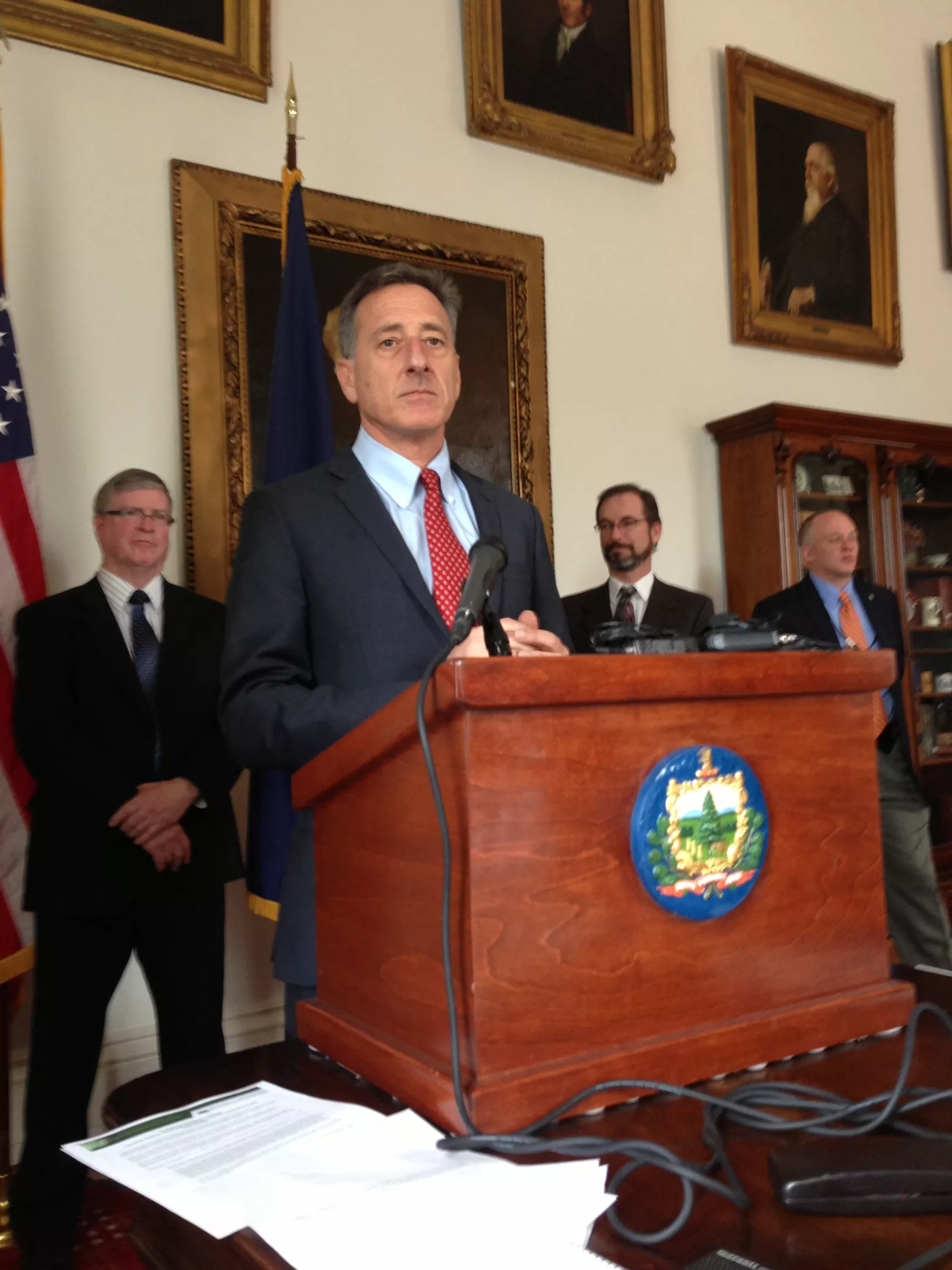
How much does Gov. Peter Shumlin hate on the Vermont House's tax bill?
So much so that he'd rather kill himself than sign it.
No, seriously. That's how he put it Wednesday when asked at his weekly press conference by Vermont Public Radio's Kirk Carapezza, "Exactly how much do you not like it?"
"Exactly very much," Shumlin responded.
"Can you give us an analogy?" Carapezza pressed, surely looking for that perfect soundbite for this evening's local All Things Considered newscast.
"Sure," Shumlin said, pausing for a moment. "If you told me that I had to jump from a window, I would go for the highest building that I could possibly find to jump to make sure that I wasn't here to see that tax package become law."
As we noted in this week's Fair Game, Shumlin's, um, strong distaste for the House's proposed $23 million tax increase stems from his longstanding desire to avoid raising so-called "broad-based" taxes.
Shumlin elaborated on that distaste during Wednesday's Statehouse press conference, saying, "I do not believe we should raise income taxes on hardworking Vermonters, sales taxes on hardworking Vermonters and meals taxes on hardworking Vermonters. And the irony is, we don't need to! This is entirely unnecessary in my judgment."
He also pushed back on the notion that the House's tax plan is more progressive than his own, though theirs includes an income tax increase on high-income Vermonters, while his mostly hits low-income taxpayers.
"As I've mentioned before, Vermont already has a very progressive income tax," he said. "You know, we ask right now a very small portion of taxpayers — I'd be happy to show you the chart — to pay... a huge chunk of Vermont's income tax."
But if you keep gouging the rich, he argued, you'll end up with fewer and fewer wealthy people to tax.
Monday, March 25, 2013
Here's what's up in Vermont news and politics this week. Got a newsworthy event for next week's calendar? Email by Friday to submit.
Monday, March 25
- It's legislative breakfast day! At 7:30, Lt. Gov. Phil Scott gives a mid-session update to the Randolph Chamber of Commerce at Gifford Medical Center (then rides something called the "Maxi Taxi.") And at 8:15, Gov. Peter Shumlin is in St. Johnsbury to address the Northeast Kingdom Chamber.
- Live at 11, Reps. Terry Macaig (D-Williston) and Jean O'Sullivan (D-Burlington) are on Channel 17. Watch.
- At noon, University of Vermont prez Tom Sullivan will be on "Vermont Edition" to talk about his first year in office — and what he's doing to keep UVM "affordable" for Vermonters. Listen live.
Rest of the week after the break...
Friday, March 22, 2013
In the fight against Vermont Gas' proposed Addison County natural gas expansion, it's largely been landowners piping up with concerns about the project, which would run a natural gas transmission line south through Vergennes and Middlebury — and potentially on to Ticonderoga, N.Y. Until now.
A rally last night at Champlain Valley Union High School illustrated that property owners aren't the only ones balking at the pipeline extension. A growing grassroots coalition of environmentalists and workers' rights advocates, singing solidarity songs and brandishing banners, gathered in front of the high school to make their objections known prior to the start of a Public Service Board public hearing on the project.
Chief among their concerns is the environmental impact of extending a pipeline that carries fossil fuel deeper into Vermont. In particular, the protestors are unhappy that the pipeline would carry a portion of gas obtained in Canada using hydraulic fracturing, commonly known as "fracking" — Vermont Gas concedes that this is the case. Vermont lawmakers last year passed a law making the Green Mountain State the first in the country to ban fracking. It's a technique oil and gas companies love, because it opens up vast reserves of shale gas previously too costly or difficult to extract. Environmentalists have long raised the alarm, however, pointing to problems with groundwater contamination, waste water disposal and even earthquakes in places where fracking is underway.
"I am concerned about the hypocrisy of Vermont to on the one hand ban fracking and on the other use gas from somebody else's devastated landscape," said Rebecca Foster, a Charlotte resident who turned out for the rally and PSB hearing.
Thursday, March 21, 2013
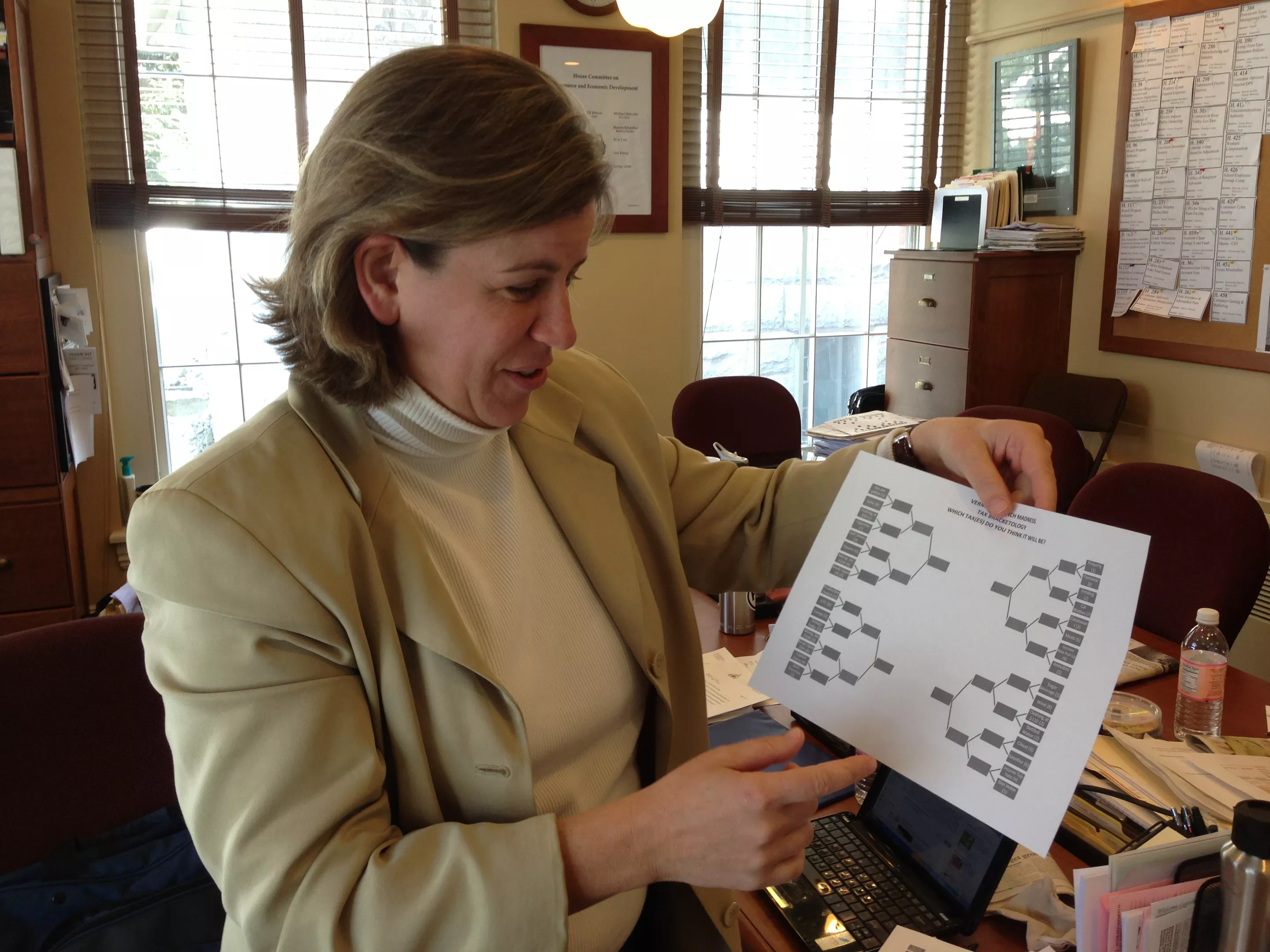
March madness has hit Montpelier.
As she sat in committee yesterday, Rep. Heidi Scheuermann (R-Stowe) was eyeing her NCAA tournament bracket alongside a list of potential revenue sources legislators are considering to plug the state's budget gap.
Then it dawned on her: It's as tough right now to figure out what the legislature will wind up taxing as it is to predict who'll make the Final Four.
"It's madness! Really, I was just thinking it's madness," Scheuermann says. "It's like we're playing darts. We'll try this and then we'll try this."
And so, another bracket was born.
This morning Scheuermann slipped copies of her "Vermont March Madness Tax Bracketology" in every mailbox in the Statehouse. Throughout the day, legislators have been spotted filling them out.
Nine months after putting its headquarters up for sale, the Barre-Montpelier Times Argus has found a buyer — and you'll never guess who it is.
Actually, you will: Barre Mayor Thom Lauzon.
As the T-A itself reported Thursday, Lauzon's real estate company, Metro, has signed a purchase and sale agreement for the 23,000-square-foot building with Times Argus owner R. John Mitchell.
In addition to serving as mayor, Lauzon is one of the largest landowners in Barre. He declined to tell Seven Days Thursday how much he paid for the North Main Street property, but said it was less than the $895,000 listing price.
Is it a little awkward for a key political player in the T-A's hometown to cut a six-figure check to its publisher?
"No, not at all," Lauzon says. "Listen, I don't expect special treatment from anyone and I don't need special treatment from anyone."
Wednesday, March 20, 2013
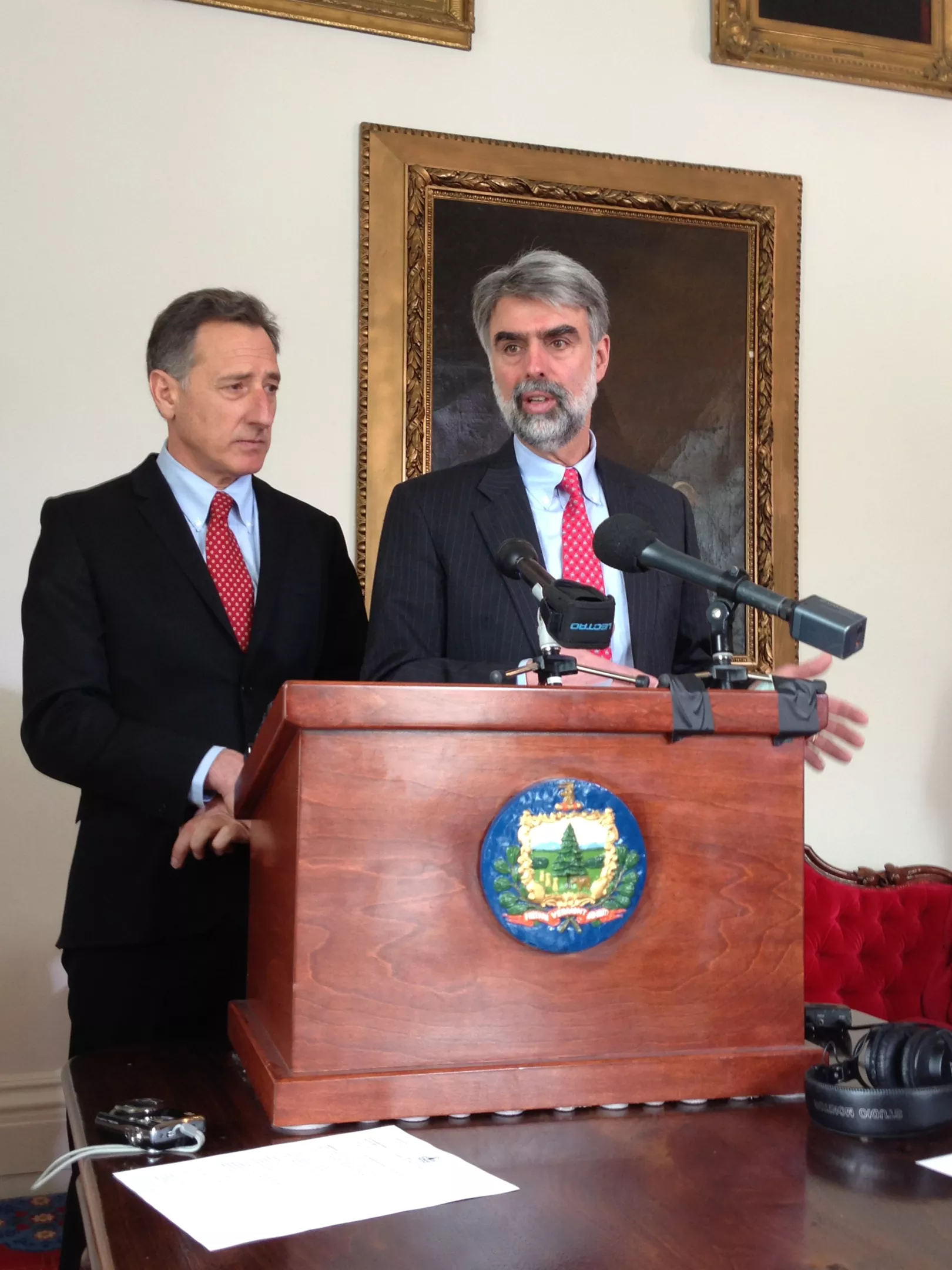

Upset by an Associated Press account of alleged cost overruns in the relocation of a state agency, Gov. Peter Shumlin ripped into the story Wednesday during his weekly press conference.
"Let me just say every once in a while there is something that is printed that isn't true," Shumlin said. "And that story is not true."
AP Statehouse reporter Dave Gram wrote Monday that members of a House committee were told last year that the Agency of Natural Resources' move to the National Life building in Montpelier would cost roughly $2 million. Recent estimates peg the cost of relocation and renovation at closer to $8.7 million — $3.5 million of which would be covered by National Life.
But according to Shumlin, that original estimate was never uttered by his administration.
"We never said that it would cost $2 million," Shumlin said at the press conference, which was attended by Gram. "I don't know where that number came from. I don't deny it might've been said to the committee, but all I can tell you is it wasn't said by us."
Clearly prepared for the push-back, Shumlin then summoned Secretary of Administration Jeb Spaulding (pictured above at right with Shumlin) to the podium to deliver a blow-by-blow account of the state's cost estimates. Spaulding said the administration's earliest expectations last spring ranged from $6 to $10 million. A written estimate provided to the House Committee on Corrections and Institutions in July pegged it at $7.5 million, he said.
Vermont and Arizona don't have a whole lot in common. The Grand Canyon State has blazing hot deserts, we shoveled out our cars on the first day of spring. They're mostly red, we're deep blue. They've got scorpions, we've got moose. So what links our two states, apparent opposites geographically and politically? Gun rights.
Guns & Ammo magazine released its list of the best and worst states for gun owners last week, and Vermont tied with Arizona at the top of the heap. The magazine's graphic, at right, confusingly says Vermont is number 2 and places the state in the crosshairs (why shoot Vermont if it's awesome for guns?), but the Green Mountain State and the Grand Canyon State are level on points atop the list. Each came one point short of a perfect score.
Done scraping the ice off your windshield on this first day of spring? Good. Because there's a new Seven Days awaiting on newsstands, online and on the app. This week's lineup of news and politics features...
- In this week's cover story, Paul Heintz profiles Sen. Patrick Leahy. Vermont's senior senator wields more clout than ever on Capitol Hill, and he won't say what his future holds.
- Accused cop car crusher Roger Pion is one of many Vermont defendants ruled incompetent to stand trial due to traumatic brain injuries. But what happens to TBI-afflicted defendants after their charges are dismissed?
- Neighbors have raised concerns over a natural gas pipeline's proposed extension through Addison County and across Lake Champlain. Why is the pipeline so important to Ticonderoga's International Paper in New York?
- This week in Fair Game: Burlington's city council is evenly split between Democrats and everyone else — and the vote to elect its next president could very well end in a stalemate. Plus, Jim Douglas talks rebranding Republicans, and Paul Heintz shines a light on some job shuffling in the ranks of the state's government workers.
Cover photo by Charles Steck.