

Thursday, May 13, 2021

President Laurie Patton and other college officials jointly announced Thursday that students, staff, and faculty who live, work, and learn on the campus must all get vaccinated. The intent, the administrators said, is to help the college safely return to more normal, in-person classes.
"Scientific research tells us that vaccination of the vast majority of our community will provide the best possible protection against COVID-19," Patton wrote in a statement to the college community. "We expect that once most individuals are vaccinated, we will be able to relax restrictions, move away from testing and capacity limits, and resume more activities and events."
Like other Vermont colleges that plan to take similar steps, Middlebury may grant individual exemptions for religious or medical reasons.
Saint Michael's College, Norwich University and Champlain College, which have all previously said they will expect students to be vaccinated, also said they will offer exemptions.
Tags: Middlebury College , COVID-19 , vaccination , Web Only , Image
Tuesday, May 11, 2021

In preparation, the state is setting up clinics at more than 40 schools around the state, and families will also be able to register for a vaccine at Kinney Drugs or CVS, officials said on Tuesday at one of the Scott administration’s regular COVID-19 press briefings.
Vermont has an estimated 27,000 children in that age group, state officials said.
The CDC’s Advisory Committee on Immunization Practices is meeting on Wednesday to discuss the Pfizer vaccine, which was approved by the U.S. Food and Drug Administration on Monday. The committee is expected to recommend use of the vaccine, said state Health Commissioner Mark Levine. The CDC will then send instructions and guidance for its administration to the states.
Moderna and Johnson & Johnson shots have not yet been approved for people under age 18.
“Vermont has been preparing for this,” Levine said. “We’ll be ready to offer the vaccine to this age group almost immediately.”
Tags: Vermont , COVID-19 , coronavirus , vaccine , Web Only , Image
Friday, May 7, 2021

On Thursday, Champlain College in Burlington announced that it would require all students to be fully vaccinated before the start of the fall semester, pending U.S. Food and Drug Administration approval of the vaccines.
Under the current emergency authorization order, some experts contend that vaccine mandates exist on shaky legal ground. But full approval will make such requirements "a little more feasible," John Grabenstein, a former executive director of medical affairs for vaccines at Merck and a former Department of Defense immunologist, told NBC News.
Pfizer filed a request on Friday for FDA approval for its COVID-19 vaccine, a process that public health officials estimate could take up to six months.
St. Michael’s, a private Catholic college in Colchester, will also require students to get vaccinated before returning to campus in the fall, according to spokesperson Alex Bertoni.
Employees, Bertoni said, will be “strongly encouraged” to get shots.
Tags: coronavirus , vaccine , COVID-19 , colleges , mandate , required , St. Michael's College , Champlain College , Middlebury College , University of Vermont , Norwich University , Web Only , Image
Friday, April 30, 2021

He also updated the state's outdoor mask mandate following the release of new guidance from the U.S. Centers for Disease Prevention and Control. Vermonters, regardless of whether they are vaccinated, no longer need to wear facial coverings outdoors when physical distancing can be maintained, though businesses and municipalities can enact stricter rules if they want.
"As an example, if you're walking down the street, you don't need to wear a mask," Scott said at a press conference. "If you're at the dog park and you're not in a crowd, you don't need to wear a mask. If you're with people outdoors in accordance with the gathering policy, you don't need a mask."
Tags: Vaccinations , Mask Mandate , Reopening Plan , Gov. Phil Scott , Web Only , Image
Friday, April 23, 2021

The Vermont Health Department announced that resumption in a press release Friday night, hours after a panel of advisers to the Centers for Disease Control and Prevention ended its recommended pause on the vaccine.
“I appreciate the transparent effort made by the CDC and FDA in reviewing the facts during the pause," Gov. Phil Scott said in the press release. "This demonstrates the commitment we all have to ensuring vaccine safety. I encourage all Vermonters who are eligible to get vaccinated as quickly as possible, with whatever vaccine is available and most appropriate.”
Tags: Johnson & Johnson , Vaccine , COVID-19 , Blood Clotting , Resume , Web Only , Image
Friday, April 16, 2021

Vermonters ages 16 to 18 may register for vaccines on 10 a.m. Saturday, two days earlier than others in the previously designated 16 to 29 age group. Older members of the group can register beginning at 6 a.m. on Monday.
Gov. Phil Scott said the head start came out of "empathy" for high school students who have had a difficult year. He also noted that the students might otherwise have trouble scheduling timely appointments because the Pfizer vaccine is the only one of three currently approved for people ages 16 and 17.
Tags: COVID-19 vaccine , COVID-19 vaccine registration , Pfizer vaccine , high school , Gov Phil Scott , Web Only , Image
Thursday, April 15, 2021

The Guardian newspaper teamed up with Consumer Reports to sample 120 water systems in the nation, and found that almost all of them — 118 of 120 — had detectable levels of lead, arsenic or PFAS chemicals found in household products from cookware to rugs.
Included in the report was a noteworthy test result from Shelburne that indicated PFAS levels of 5.77 parts per trillion. That’s well below the federal advisory level of 70 parts per trillion and Vermont’s more stringent 20 parts per trillion level.
But it is more than has been reported by the water system serving much of Shelburne, the Champlain Water District, raising questions about how the contaminant made it into the sample.
“We don’t have any PFAS detected in our source water,” said Joseph Duncan, general manager of the Champlain Water District.
The district delivers drinking water from Shelburne Bay to 75,000 people in eight towns, including South Burlington, Essex and Milton.
The district samples for PFAS both at its treatment plant on Queen City Park Road and at points in the water distribution network, but not in people’s homes, he said.
Tests performed in 2019 and in 2020 both came back as “non-detect,” meaning the sample has less than 2 parts per trillion, and the five PFAS compounds Vermont regulates were considered not detected. The Guardian story also included a result of 1.74 parts per trillion from Bennington, but that falls below what is considered detectable by the state.
Complicating the issue is that the sampling regimen utilized by the publications relied on volunteers, and the conditions under which the water sample was taken could not be confirmed.
PFAS chemicals are prevalent in clothing and a range of consumer goods, and sampling must be done with precision, Duncan noted.
“At the parts-per-trillion level, you have to be very careful with how you collect the sample in order to not cross-contaminate it and wind up with a false positive,” Duncan said.
He stressed he was not questioning the competence of the volunteers or the value of the reporting, and said he supports greater public awareness of water quality issues. Nevertheless, a single data point from an unknown origin that doesn’t align with the district’s own regular sampling results makes drawing conclusions difficult, he said.
Water quality advocate James Ehlers said he found it telling that the district was sampling at the source and not at the point that really matters to customers — the tap.
“I think the way that you sample, in large part, can determine the results that you get,” Ehlers said. “It’s really easy not to find something you’re not looking for.”
The state Department of Environmental Conservation required water systems in Vermont to test for the five PFAS chemicals it regulates following the 2016 discovery of widespread contamination of groundwater in Bennington.
A toxin called perfluorooctanoic acid, also known as PFOA, was detected in private wells near a North Bennington manufacturing plant once operated by Saint-Gobain Performance Plastics. Among other fines, the company has agreed to pay $25 million to extend municipal water service.
The subsequent testing has turned up 10 water systems in the state, most of them small, that have had results above the 20 ppt standard since 2019. They range from Mount Holly School at 323 parts per trillion to others like the Killington Village Inn at 20.03 parts per trillion. The state is helping the systems perform the testing and fund fixes where possible.
Water systems aren’t the only places where the class of chemicals is turning up. Contamination from the Vermont National Guard Base in South Burlington is reaching the Winooski River, as Seven Days reported in 2019.
For years, soldiers trained with and used firefighting foam containing PFAS, which seeped into the ground and reached groundwater. The Guard has spent millions on cleanup and monitoring efforts that are expected to last years.
Ehlers says a more aggressive response is needed.
“The state needs to be taking this as seriously as it took COVID,” Ehlers said.
There is a bill in the legislature, S.20, that seeks to restrict the sale of consumer products containing PFAS, including some firefighting foam, food packaging, rugs, ski wax and children's toys.
Ehlers says the bill doesn’t go far enough, and should also ban all fluorinated firefighting foams and force landfills to contain their leachate.
Despite the water quality challenges of Lake Champlain, Shelburne Bay is a safe source of drinking water, Duncan said. The water is taken from two intake points in a trench 80-feet below the bay, where surface contamination rarely reaches, he said.
Shelburne Bay is fed by Potash Brook in South Burlington and the LaPlatte River in Shelburne, and contains roughly 3 billion gallons of water, so any PFAS flushing into it would be highly diluted, Duncan noted.
The contamination reported in the Guardian could have been introduced after the water left the lake, from sources such as waterproof tape wrapped around pipe fittings or materials in the fixtures themselves, he said.
While water sampling is generally best done by professionals, Duncan said he supports greater citizen awareness of the problem and legislative efforts to clamp down on PFAS products.
“The more we continue to produce materials with PFAS, the more prevalent it could potentially become in our environment and have the potential to work its way into different water sources,” Duncan said.
Tags: water quality , PFAS , Shelburne , James Ehlers , Web Only , Image
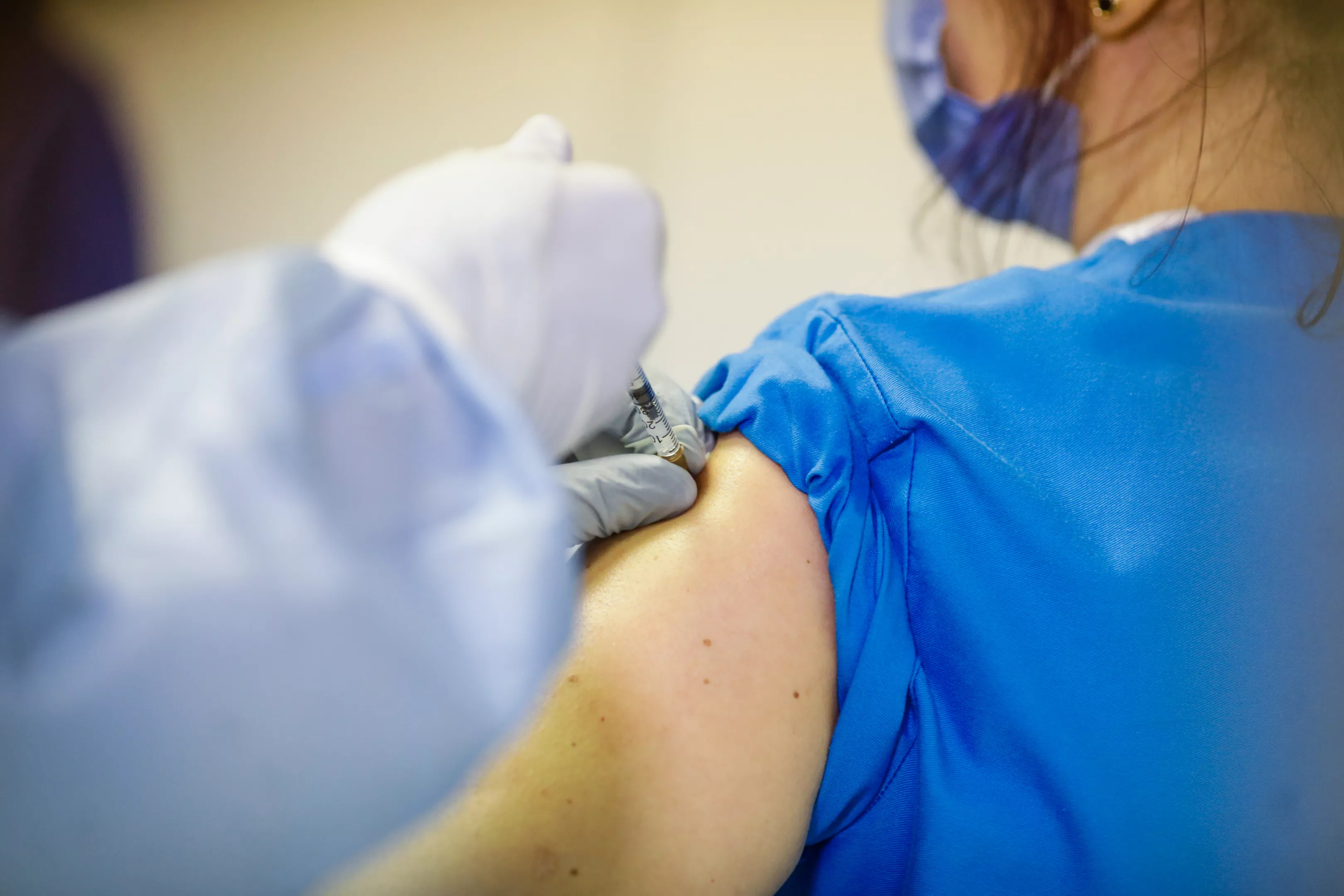
Following federal guidance, Vermont is extending a "pause" on administering COVID-19 vaccines made by Johnson & Johnson through at least April 23.
The Vermont Department of Health announced the move Thursday. It comes after members of a U.S. Centers for Disease Control and Prevention advisory panel met on Wednesday and said they needed more time to review a possible link between the vaccine and an extremely rare type of blood clot.
Tags: COVID-19 vaccine , Johnson & Johnson vaccine , Vermont Department of Health , Web Only , Image
Tuesday, April 13, 2021

Vermont has followed federal recommendations to suspend the use of the Johnson & Johnson COVID-19 vaccine, but officials delivered an upbeat message Tuesday at the administration's twice-weekly news briefing.
“This is a bump in the road in terms of the Johnson & Johnson pause,” said Gov. Phil Scott.
The U.S. Centers for Disease Control and Prevention reported early Tuesday that six women between ages 18 and 48 suffered a type of blood clot called cerebral venous sinus thrombosis, six to 13 days after receiving the vaccination. More than 6.8 million doses of the Johnson & Johnson vaccine had been administered in the U.S. as of April 12, the CDC said.
The CDC recommended that states suspend Johnson & Johnson vaccinations, and Vermont is one of several that did so, officials said.
“But we’re still, even without the J&J vaccine, going to vaccinate more than 20,000 people this next week,” said the governor. “Think about how far we have come. Three to four months ago, we didn’t even have a vaccine in place. We should be proud of what we are doing. I believe J&J will be back online sooner rather than later.”
Tags: Johnson & Johnson , vaccine , Vermont , clinic , public health , Phil Scott , Web Only , Image
Tuesday, April 6, 2021

"I think we’ve done a good job on this bill," said Rep. Ann Pugh (D-Burlington) said. "It will save lives."
This year, the committee took additional testimony, including from Chittenden County State’s Attorney Sarah George, who has declined to prosecute misdemeanor buprenorphine and similar drug possession cases since 2018.
She did so because this class of drugs “literally block the craving for heroin” and are an integral part of medically assisted drug treatment programs, she said. While there was some skepticism about the policy, including from law enforcement, George said in the year after it took effect, overdose deaths in the county dropped by 50 percent.
"This bill is really a modest step toward recognizing the harm that criminalizing substance use has done on individuals who use drugs,” George told lawmakers. “It tells people that we care about them, that we want them to survive.”
“When given the option in the community of possessing heroin or possessing buprenorphine, we want them to — in fact we encourage them to — possess buprenorphine,” George said.
People under age 21 found with less than 224 milligrams of “bupe” would be given a ticket and referred to a drug diversion program. First offenders who fail to complete the program would face a civil fine of $300 and 30-day license suspension. Second and subsequent offenses would lead to $600 fines and up to 90-day license suspensions.
Before he became consumed by the COVID-19 response, Health Commissioner Mark Levine cautioned lawmakers against the decriminalization effort, arguing that it might make addicts less likely to participate in supervised treatment programs.
Supporters responded that recovery is different for different people, and not everyone has access to drug treatment that works for them.
Tags: buprenorphine , heroin , drug policy , Ann Pugh , Sarah George , Web Only , Image