

Monday, March 3, 2014

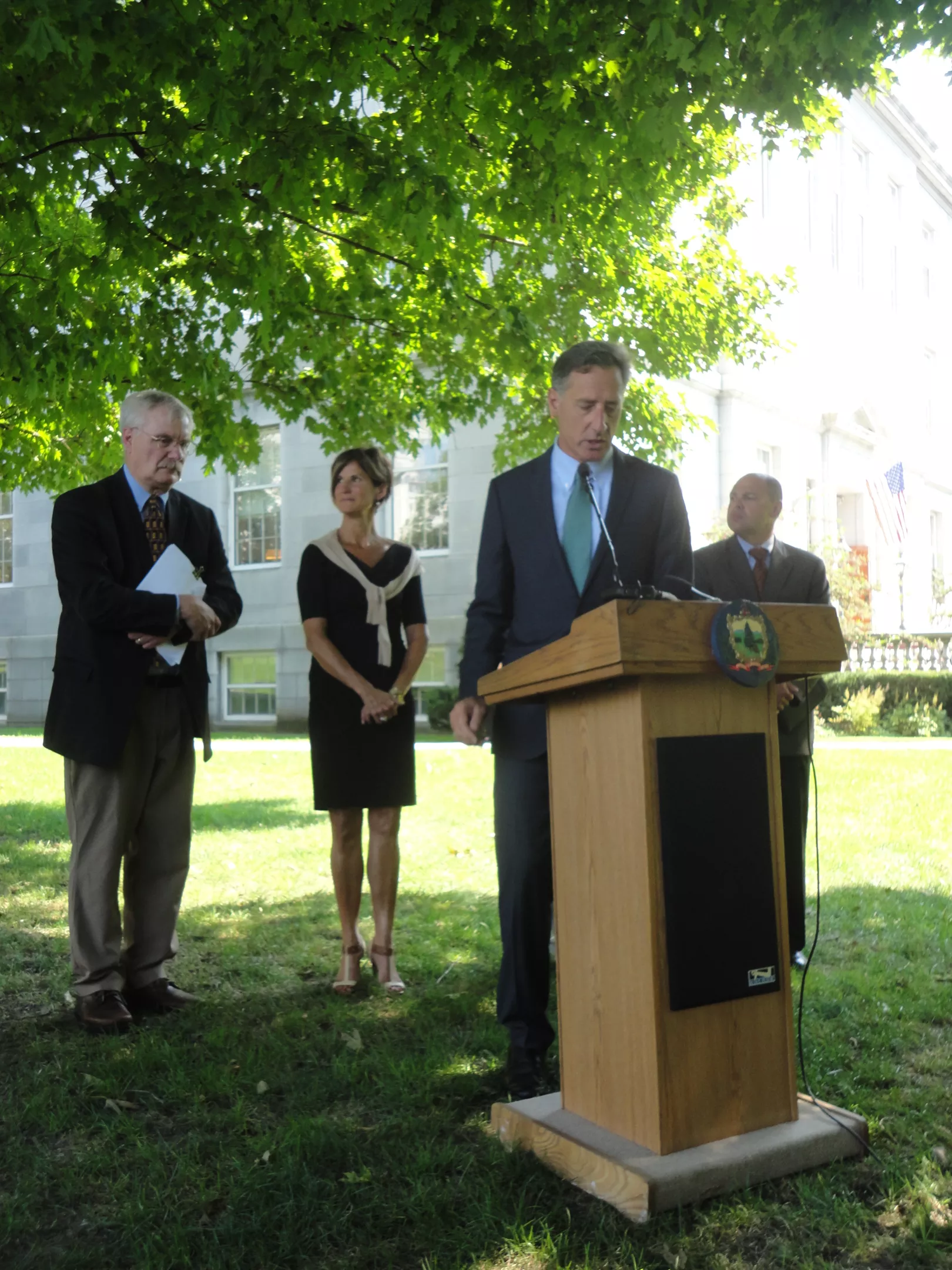
All Vermont State Police troopers and emergency medical technicians will soon carry a drug that can reverse opiate overdoses, Gov. Peter Shumlin announced at a press conference today.
Flanked by national drug czar Gil Kerlikowske and a phalanx of state officials, the governor unveiled his latest initiative in combating opiate addiction, which has become a centerpiece of his agenda.
Thus far, naloxone (commonly known by trade name Narcan) has saved the lives of seven Vermonters, Shumlin said.
The state has already dispensed 400 doses to the HowardCenter, another 100 to the Good Neighbor Health Clinic in White River Junction. Officials said they plan to begin sending doses to other "hub" facilities in the state's drug treatment system, starting with Rutland.
Tags: Narcan , opiate , Opioid Crisis , overdose , Shumlin , Image , Web Only
Saturday, February 15, 2014

Each weekday, Seven Days scans the news across the Vermont media landscape to find the smartest, best and most compelling stories. We bundle them up in an email and send them out to our subscribers early each afternoon. It's called the Daily 7.
So which Vermont news stories are you reading? And which should you be reading? Here are the stories you clicked on most from this week's editions of the Daily 7:
 Schumacher Begged Police for Help for Two Days Before Husband Killed Son
By Laura Collins, the Daily Mail — Wednesday, February 12
Christina Schumacher says she attempted to get full custody of her son, believing him to be in danger, just before he was killed by his father in December. She says her estranged husband had been abusive for years.
 Homicide Victims Identified as West Haven Father and Son; Suspect Arrested
Staff report, Rutland Herald — Thursday, February 13
A man was arrested Thursday morning in connection with the murder of a father and son in Hubbardton Wednesday.
Tags: Christina Schumacher , crime , drugs , health , heroin , law enforcement , Opioid Crisis , Peter Shumlin , Sonny Schumacher , Statehouse , suboxone , Weekly 7 , Image , Web Only
Monday, February 10, 2014
Gov. Peter Shumlin made his Sunday morning talk show debut this weekend with an appearance on ABC's "This Week."
The topic? You guessed it: Vermont's "full-blown heroin crisis."
Shumlin appeared with guest host Martha Raddatz, ABC News correspondent Dr. Richard Besser and journalist Seth Mnookin, who wrote last week in Slate about his own struggle with heroin addiction. The segment segued from actor Philip Seymour Hoffman's death by heroin overdose last week to Shumlin's State of the State address, in which he focused on Vermont's "growing epidemic" of opiate abuse.
Thursday, February 6, 2014

Find these news and politics stories in this week's Seven Days...
- In Burlington, one resident has kept up her fight against a neighbor's backyard guitar-building shop for a year and a half. The case could reach the Vermont Supreme Court.
- The Department of Homeland Security has dropped plans to run an "internal checkpoint" 100 miles from the Vermont/Quebec border — though it's too late for one man who faces deportation.
- University of Vermont researchers are working on technology to allow maple farmers to harvest sap from young saplings rather than the less-plentiful mature trees.
- As part of the love and marriage issue, here's a look back at the path to marriage equality for same-sex couples.
- In Fair Game: How one soldier's allegations of sexual assault changed the Vermont National Guard. Plus, find out who's giving big bucks to Gov. Peter Shumlin's Democratic Governors Association, and why the Committee on Committees isn't a committee — at least when it comes to letting the public and press inside.
Thursday, January 9, 2014
Immediate reaction to Gov. Peter Shumlin's state of the state address yesterday focused on his declaration that drug addiction is a public health crisis that should be tackled with prevention and treatment rather than "simply doling out punishment."
Advocates for criminal justice reform were overjoyed that the governor used his bully pulpit to declare that drug crime is primarily a "health crisis," not simply a law enforcement problem.
"I think this is profound,' said State Rep. Bill Lippert, chair of the House Judiciary Committee, in an interview. "This is a really big deal. There is a fundamental shift that's been articulated."
But Shumlin's speech also included little-noticed proposals that came from the more traditional tough-on-crime playbook.

"Well, what's there to oppose in that?" a reporter asked me a moment after Gov. Peter Shumlin concluded his 34-minute State of the State address Wednesday afternoon.
What, indeed?
For the second time in as many years, the second-term governor dispensed with tradition and focused his legislative session-opening remarks on a single topic: in this case, what he called "the rising tide of drug addiction and drug-related crime spreading across Vermont." (See Mark Davis' account of the State of the State.)
But unlike last year's education-themed inaugural address, into which Shumlin shoehorned an array of policy priorities, this year's speech barely strayed from the topic at hand. And unlike the typically jingoistic and self-congratulatory remarks governors tend to make on such occasions, Shumlin's address was a solemn and somber affair, rarely punctuated by applause.
But if you measured the gov's success Wednesday by the frequency of standing ovations, you missed the point. Because Shumlin hit it out of the park.
Wednesday, January 8, 2014
Gov. Peter Shumlin devoted his State of the State address Wednesday to highlighting what he called a "rising tide of drug addiction and drug-related crime" that he said threatens the quality of life in Vermont.
During a 34-minute speech, Shumlin said Vermont is imperiled by opiate addicts who cannot access treatment and commit crimes to raise money for drugs. The governor proposed steps to bolster treatment for addicts, shift the focus of the court system from punishment to a treatment and slap tougher sentences on out-of-state dealers who bring drugs to Vermont.
"In every corner of our state, heroin and opiate drug addiction threatens us. It threatens the safety that has always blessed our state," Shumlin said. "It is a crisis bubbling just beneath the surface that may be invisible to many, but is already highly visible to law enforcement, medical personnel, social service and addiction treatment providers, and too many Vermont families. It requires all of us to take action before the quality of life that we cherish so much is compromised."
Wednesday, September 25, 2013
Grab your favorite pumpkin-flavored coffee drink — that little chill in the morning means fall is here, and the first Seven Days of the season hit the streets today. Here's what you'll find for news and politics this week:
- In Fair Game, Paul Heintz reports that a program to encourage charitable giving by state employees is funding two anti-gay organizations classified as "hate groups" by the Southern Poverty Law Center. Plus, more staff changes at Vermont Public Radio, the Rutland Herald and here at Seven Days.
- A new methadone clinic to help treat drug addicts is now open in South Burlington, despite the ongoing opposition of some neighbors. Ken Picard talks to two patients.
- Vermont cops and docs are on the lookout for "molly," a powdered form of ecstasy. Kids these days.
- In archaeology news, the Abenaki may not have been the only early inhabitants of Vermont.
Pick up this week's issue in print, online or on the app.
This week's cover image by the late Stephen Huneck is courtesy of the Stephen Huneck Gallery. See this week's cover story about the future of Dog Mountain.
Thursday, September 19, 2013
* Updated below with new comments from Gov. Shumlin *
Gov. Peter Shumlin starred in a fundraising conference call held by the Marijuana Policy Project Thursday afternoon. In an invitation obtained by Seven Days last month, the call was billed as a "strategy" session to discuss how to legalize marijuana nationwide.
The "exclusive conference call," as MPP executive director Rob Kampia put it in the invitation, was open only to the pro-legalization advocacy group's major donors. Participants had to pledge to contribute $1000 to $10,000 to the group itself — or to pro-pot politicians.
Seven Days requested permission from MPP and the Shumlin administration to listen to the call, but was denied by the former and ignored by the latter.
"The idea was that it would be an opportunity for donors to hear from MPP staffers and from Gov. Shumlin, so we did not envision any media being on the call," MPP legislative analyst Matt Simon said Wednesday. "I don't think we have anything in particular to hide. At the same time, I'm not authorized to let you join us."
Simon added, "We figure members of the media already have plenty of opportunities to ask questions. Our donors do not."
Tags: cannabis related , Web Only , Image
Monday, September 2, 2013
Principal Bobby Riley insists both the school and the neighborhood are safe, but Jeff Sherman, a resident of one of the units in the 69-85 block of Spring Street, describes conditions there as "pretty bad." The sense of danger has grown in the 12 years he's lived there, Sherman says.
In February 2011, a domestic assault spilled onto the street in front of the elementary school, whereupon a man fired a shot that didn't hurt anyone. The students were on vacation that week, but Wheeler went into lockdown to protect the staff inside.