

Tuesday, March 16, 2021
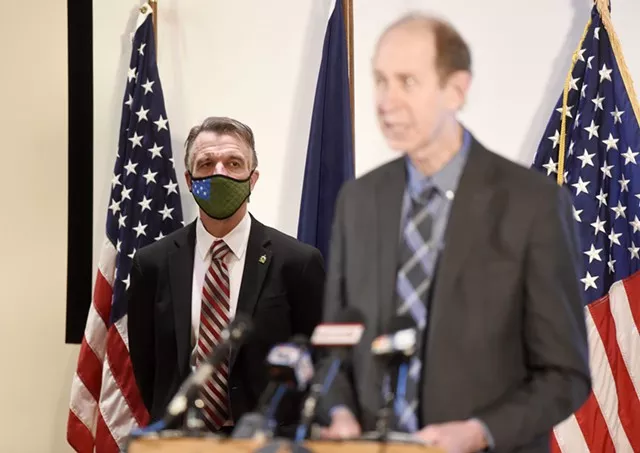
“But from my standpoint, it’s almost like we’re back to where we were pre-pandemic in terms of having businesses open and being able to freely travel throughout the United States,” Scott said of midsummer during one of his twice-a-week COVID-19 briefing.
Tags: COVID-19 , Phil Scott , governor , briefing , coronavirus , business , opening , vaccine , Web Only , Image
Monday, March 15, 2021

Things are looking up this summer. The foundation plans to run its boys’ and girls’ camps in Salisbury at 80 percent capacity. Thanks to $150,000 in state grants, more than $1 million from the federal Paycheck Protection program, and an array of private grants and donations, “We are pretty much whole right now,” said Keewaydin camp director Pete Hare. He noted that he’s not sure about the fate of the foundation’s camp in Canada, which won’t open should the border remain closed. But “if we’re able to open up camp this summer, we should be completely back on our feet,” he said.
A massive infusion of state and federal grant money last year appears to have helped small businesses survive, and in some cases even bolster aspects such as their web presence. That's based on anecdotal evidence, since nobody has yet fully analyzed how Vermont's small businesses have fared.
A new report shows Vermont spent $330 million last year on the business grants, which were administered by the state Agency of Commerce and Community Development. Businesses that proved they had suffered losses received up to $300,000.
Tags: hospitality industry , coronavirus , grants , Web Only , Image
Friday, March 12, 2021
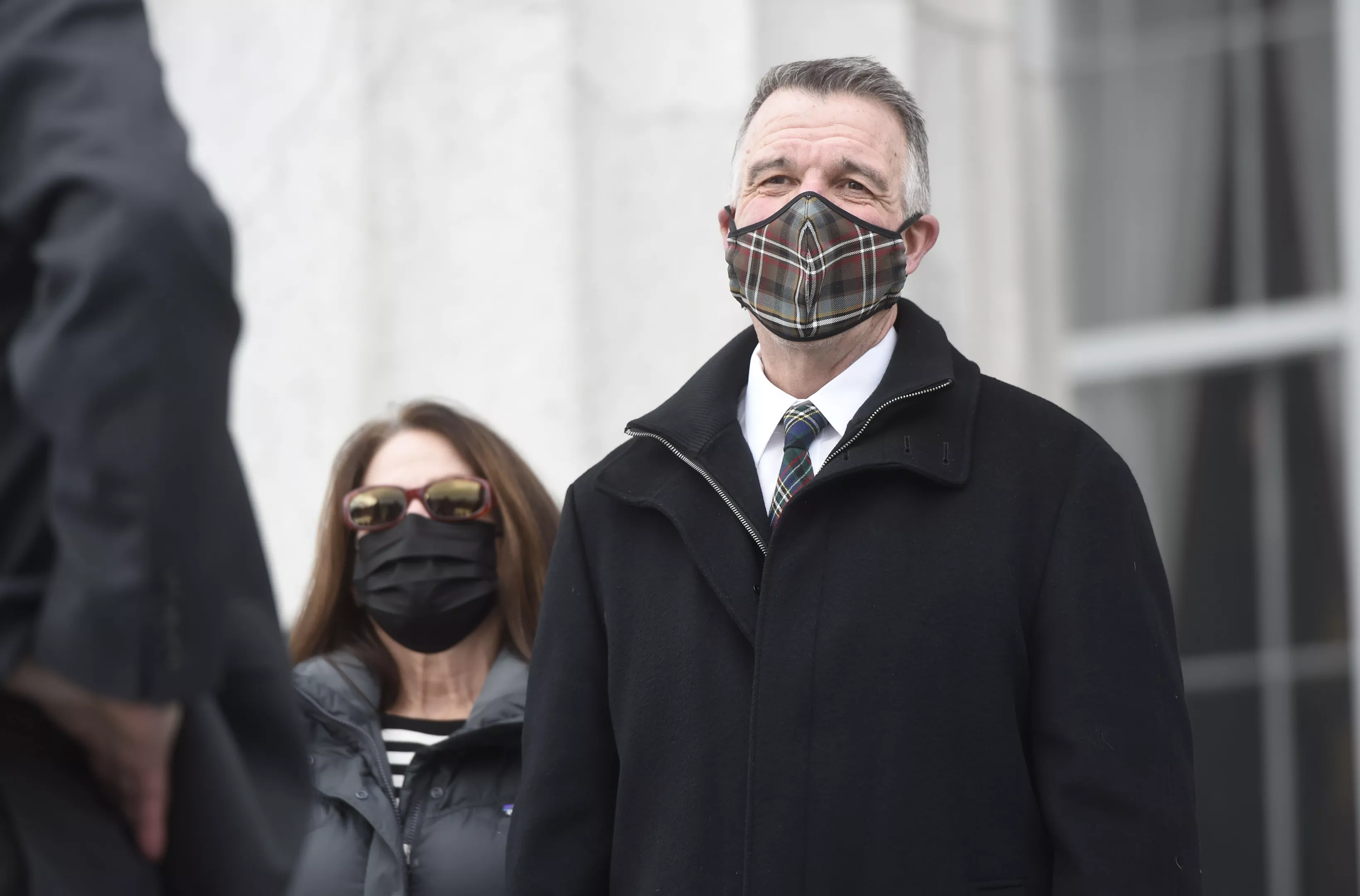
Gov. Phil Scott announced on Friday that unvaccinated people from two separate households can socialize, as long as they wear masks and keep a six-foot distance. Vaccinated Vermonters can also be a part of those gatherings, Scott said.
Earlier this week, the state said vaccinated households could get together and include one unvaccinated household. Friday's change, which is effective immediately, is the next most substantial shift in guidance for social gatherings since Thanksgiving, when Vermont banned such get-togethers due to climbing case counts.
Earlier in the pandemic, unvaccinated Vermonters were allowed to convene with one other “trusted household.” The new rule permits unvaccinated households to have multiple trusted households, as long as they gather with just one of those households at a time.
People from multiple households can now also dine out together. Up to six people can be seated at the same table in a restaurant, Scott said.
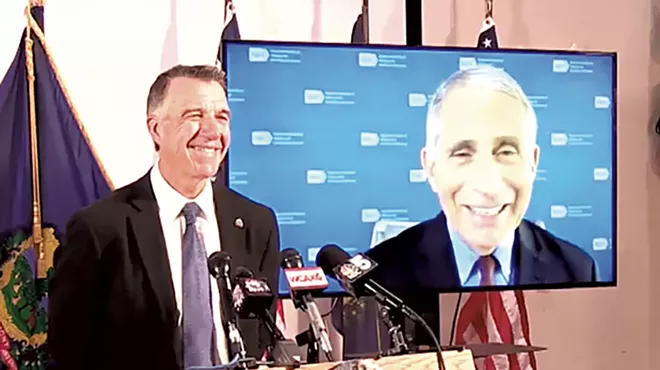
“I know these changes are not as big as many other states, including those in our region,” Scott said. “But we feel they’re positive and safe steps forward, and you can expect more ‘spigot turns’ next week.”
Tags: Vermont , COVID-19 , coronavirus , vaccine , eligibility , restrictions , gatherings , Phil Scott , governor , Mark Levine , health , Web Only , Image
Wednesday, March 10, 2021
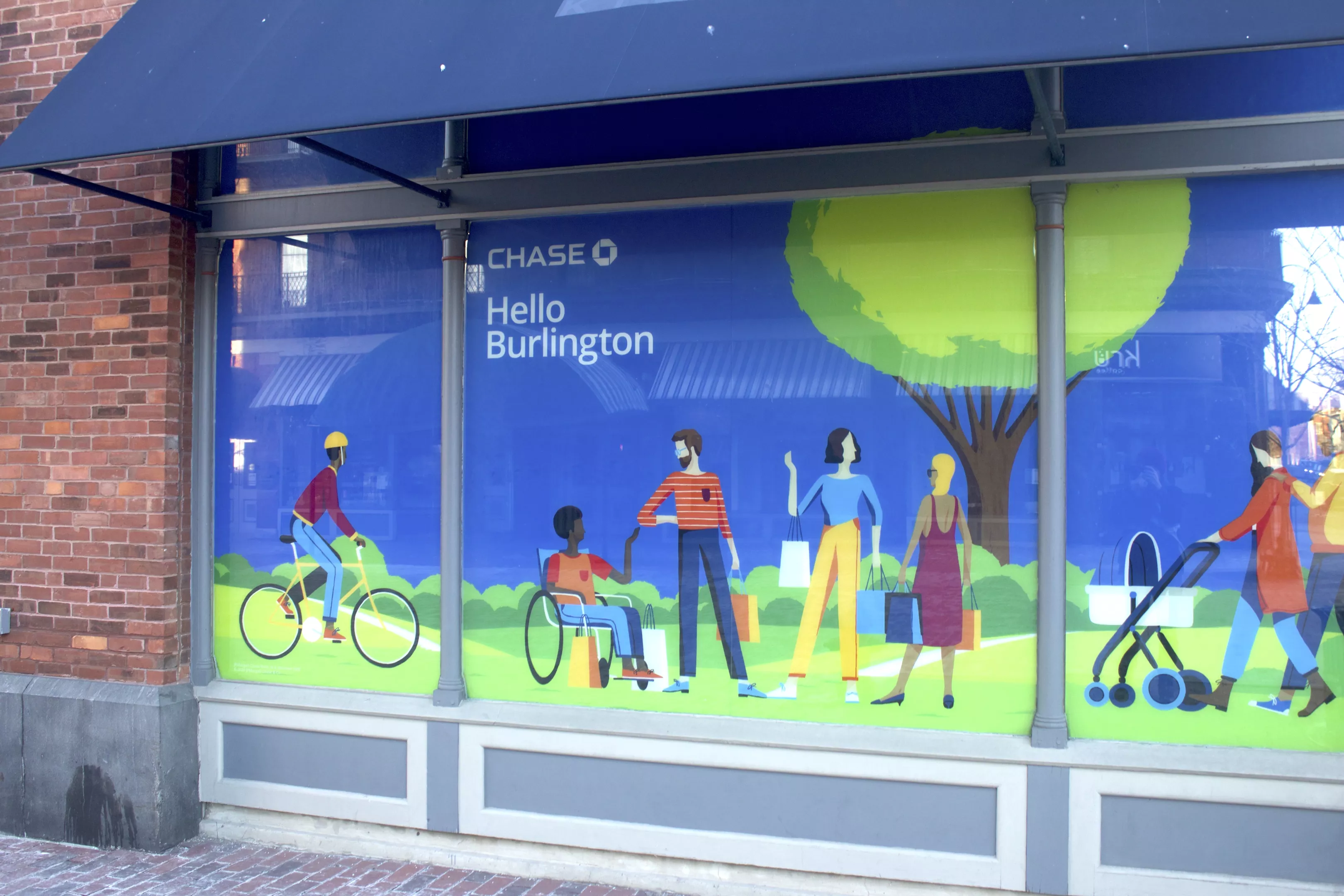
She'd noticed the window display at the former Gap store on the Church Street Marketplace earlier this winter. The large, colorful illustrations depict people riding bikes, pushing a stroller and flying a kite. But one image in particular caught Johnson’s eye.
A Black man sitting in a wheelchair is shown with his hand proffered, as if asking for change from the white man standing beside him, Johnson said. The white man has his hand on his hip and appears to be looking down at the Black man.
“I looked at it, and I said, ‘That’s not right,’” said Johnson, who is Black. “But I didn’t do anything about it.”
Until she did.
Johnson emailed city councilors last weekend with her concerns about the image, spurring a flurry of emails that eventually reached Chase. On Wednesday, the company apologized and said it will remove the ad, possibly as soon as Thursday.
Tags: Chase , Chase bank , Jenni Johnson , Max Tracy , Burlington , business , Church Street Marketplace , Church Street , Web Only , Image
Tuesday, March 9, 2021

The largest impact could come from the estimated $1.3 billion that Vermont expects to receive from the latest federal stimulus package. Vermont lawmakers had leeway over how to spend the last big infusion of cash from a COVID relief measure, the state’s $1.25 billion share of the March 2020 stimulus. That led to the creation of economic grant programs aimed at helping women and minority business owners, and some much-needed funding for childcare.
This time around, advocates need to keep lawmakers focused on helping groups that have traditionally been left out, said Lt. Gov. Molly Gray, who convened a virtual meeting Monday with 200 participants to talk about women and the Vermont economy.
“We have a moment to think really strategically not only about how we get relief money out the door with this next amount of funding, but also how do we recover stronger,” said Gray, who mentioned childcare and paid family leave as key examples of ways to help women stay in the workforce. “The moment is right in many ways to act.”
Tags: Molly Gray , women , people of color , COVID-19 relief , Web Only , Image
Monday, March 8, 2021
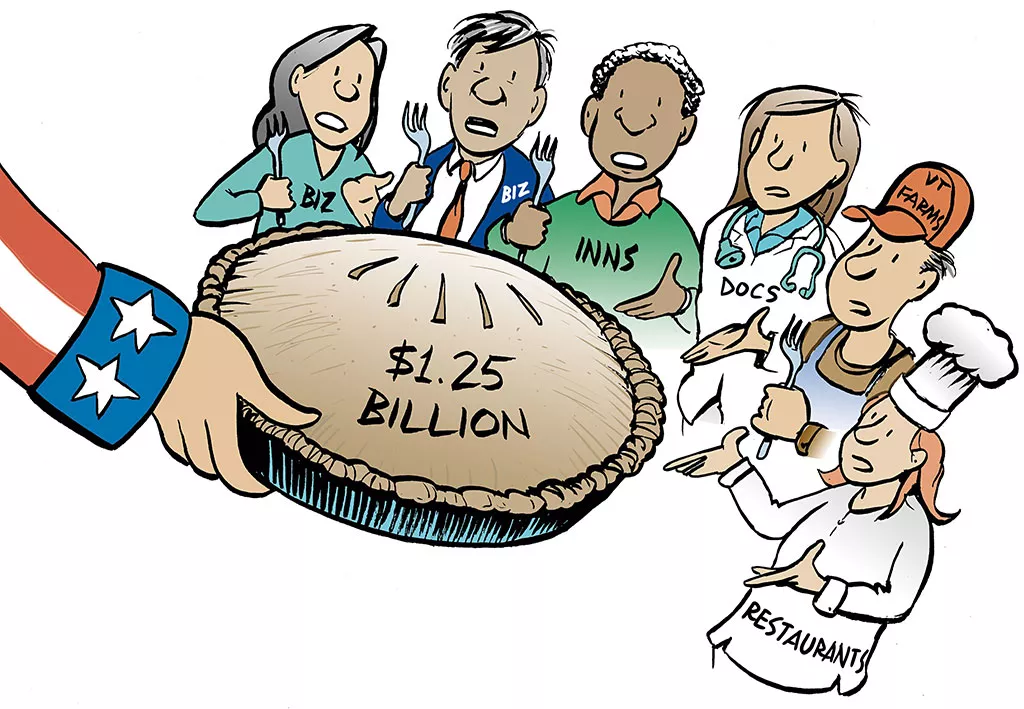
But Vermont lawmakers are already warning small business owners that it could be midsummer before they see any cash relief. Legislators must decide how and through what programs they will divvy up their expected $1.3 billion share of the pot, a process that could take months, House Speaker Jill Krowinski (D-Burlington) cautioned during a virtual Vermont Chamber of Commerce meeting on Monday.
Last year, Vermont received a $1.25 billion share of the $2 trillion CARES Act that Congress passed in March 2020. But it wasn't until early last July that the first business grants started accepting applications.
A similar scenario could also play out this time around, Krowinski said.
Tags: small business , grants , Vermont , CARES Act , stimulus , COVID-19 , Web Only , Image

The parcel, which is listed on Trulia for $3.3 million, includes sweeping views of the Adirondacks, access to two lake beaches, and an interest in 27 acres of neighboring agricultural land.
The former hayfield is one of four long-term residential leases that the Shelburne Farms nonprofit, created in 1984, sold the following year to raise money for restoration work and programs on its now 1,400-acre property. The buyers in 1985 paid more than the appraised value for three of the leaseholds as a way of helping the new nonprofit, said Alec Webb, a fourth-generation member of the family that established Shelburne Farms and the president of the nonprofit.
The lot is now owned by a Lintilhac family trust, according to Shelburne town records.
Shelburne Farms in recent years borrowed money from other conservation groups to purchase two other leaseholds in that area, known as Windmill Hill.
Tags: Shelburne Farms , real estate , Web Only , Image
Thursday, March 4, 2021
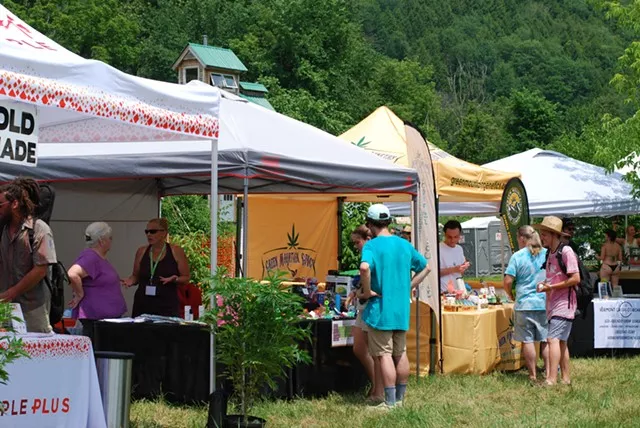
Heady Vermont, the cannabis industry group that expanded in 2019 into a new 3,000-square-foot headquarters in Burlington, is on an indefinite hiatus, said founder Monica Donovan.
Donovan said that no events or publications are planned, and she doesn't know if she'll continue with Heady. "I’d love to, but won’t know positively for a while," she said by text on Wednesday.
The 5-year-old membership organization published a weekly "News Roll Up" and organized events for businesses and consumers, including an annual trade show at the Champlain Valley Expo. At its peak last year, it had an all-female staff of six. But the pressures of the pandemic shutdowns were too much for Heady, said Kathryn Blume, the former communications director, who left last summer as work dwindled.
“Events were one of our primary income streams, and if you can’t have events, that makes things really hard,” said Blume, who now works in communications for NurseGrown Organics CBD in Underhill. “Also, the fact that it took so long to get the tax-and-regulate bill passed meant that a lot of businesses who would have been business partners for us were on hold as well, and then the financial uncertainty of the pandemic was, I think, a perfect storm.”
Tags: cannabis , tax-and-regulate , Eli Harrington , Heady Vermont , Cannabeat , Web Only , Image
Wednesday, March 3, 2021

Thanks to the town's voters, store owners Andrew and Kelly Swett hope to add cannabis to that list — not the CBD that’s already available on the counter, but the THC-containing products that people use to get high.
“Things aren’t going so great in retail,” said Andrew, who was relieved on Wednesday to learn that the town had voted to allow commercial cannabis establishments, a move made possible by a bill passed last year. “It would be helpful.”
About two dozen Vermont towns considered similar measures on Town Meeting Day, and almost all passed them.
Under Vermont's 2020 law, municipalities must opt in to the adult-use marijuana marketplace through a public vote before any sales can occur. The law allows the state’s existing medical marijuana dispensaries to obtain licenses to manufacture and sell cannabis products to the public starting in May 2022. Other outlets granted retail licensees won't be able to sell until October 2022.
The towns that put the measure to a vote Tuesday are widely spread around the state, and included the large — such as Burlington, which approved the measure by a wide margin — and the small. Burke passed the measure by a vote of 133 to 130, according to the town’s treasurer.
Only three municipalities — Newport City, Richmond, and Lyndon — rejected it, according to early counts. Results from Ludlow were not yet available Wednesday.
The measure passed in Burlington doesn’t allow any marijuana sales until October 2022.
Andrew said he’s already working with one CBD supplier with whom he’d like to partner for the marijuana business. He thinks another entrepreneur who was eying Newport City will probably also try to set up shop in Brownington after that city said no to marijuana sales.
“We’re probably not going to be the only one in town,” he said. “I think it would help business in general.”
Only about 10 percent of Vermont municipalities put the matter up for a vote. More should have, said lawyer Tim Fair, who saw the results as representative of the state at large. Fair is a founder of the Burlington law firm Vermont Cannabis Solutions.
“One of the big surprises for me in this process is how the selectboards were adamantly opposed to putting this vote to the people,” Fair said. “We’re a representative democracy. We can’t agree on anything anymore, yet almost 70 percent of Vermonters agree we want a legal cannabis industry.”
Selectboards weren’t the only ones opposed. Pathologist Catherine Antley campaigned against retail sales in Middlebury, which approved the measure by a wide margin. Antley said the industry cannot be successfully regulated, and that cases involving organized crime quadrupled in Colorado after commercial marijuana was legalized. “How many Vermonters know that there is essentially no profit in the industry without the creation and maintenance of addiction,” Antley wrote in an email, adding that the industry targets young people.
Before stores can sell cannabis, the governor has to appoint a Cannabis Control Board, whose members would be full-time state employees. That process is already behind schedule. The board members’ terms were due to start January 19, but Gov. Phil Scott hasn’t yet named his choices. The law calls for the board to recommend certain fees by April 1, and to begin making rules for cannabis establishments by June 1.

Scott has been forthright with his concerns about legalizing marijuana, saying there is more work to be done in the areas of road safety, racial equity and the prevention of misuse. He allowed the legislature’s tax-and-regulate bill to become law without his signature last fall.
Eli Harrington, a Burlington-area cannabis activist who runs a website called Vermontijuana, noted that the town where the governor lives, Berlin, voted to allow commercial marijuana sales.
“Hopefully it’s a little kick in the ass for this commission to form, because that’s really what is holding things up,” Harrington said.
When things do get under way, Scott Sparks, who owns the Vermont Hempicurean CBD store in Brattleboro, has big expansion plans. Along with opening an adult-use marijuana store, he’d like to create a test kitchen to concoct edible marijuana products, expand his sales of cannabis growing supplies, and create an area for growing plants as a demonstration for visitors. He envisions the latter as a “Ben & Jerry’s-type thing for people who haven’t seen cannabis growing before.”
Tags: Cannabeat , Town Meeting Day , marijuana sales , Web Only , Image
Tuesday, March 2, 2021

“That really blew my mind,” said Krieg, who has 300 taps on 16 acres in Bethel.
In the two decades since, Krieg has watched Vermont’s maple syrup industry expand and change shape. Large operations have moved in, consolidating production. Demand for syrup has risen, but so has supply.
Nowadays, 10,000 taps is nothing special. The state’s largest sugarmaker, Sweet Tree Holdings in Island Pond, has 500,000, with plans for 1.5 million.
Tags: maple syrup , business , Vermont , Maple Farmers , Corg Krieg , Web Only , Image