

Thursday, February 13, 2014
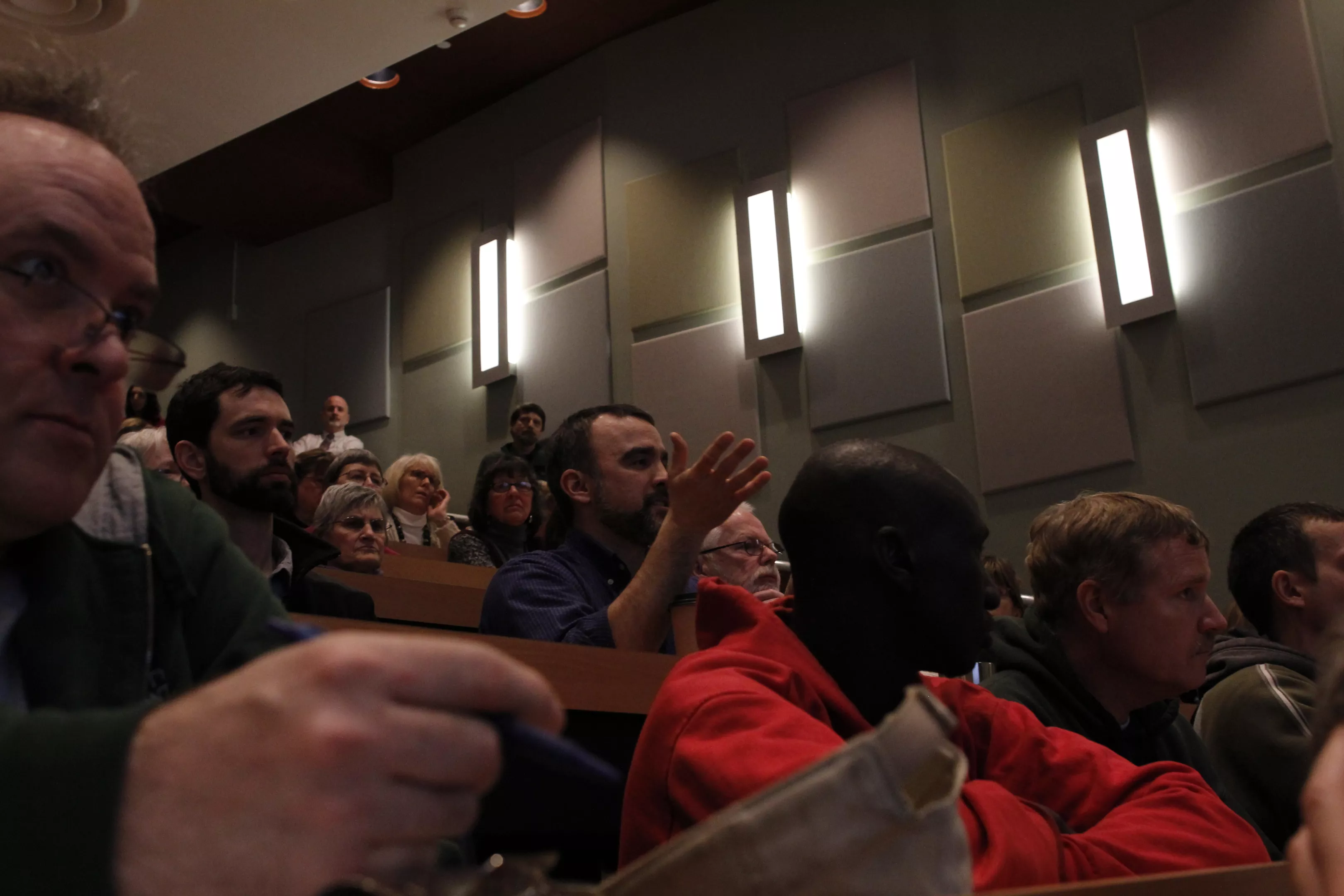
On Thursday morning, a couple hundred University of Vermont employees packed Carpenter Auditorium to express their concerns about potential increases in the amount they pay for benefits.
UVM currently offers health care and retirement benefits to faculty and staff, as well as tuition remissions for their children and other dependents. But to make up for lower revenues and increasing costs, the administration is considering shifting some of the cost of those benefits to the employees. The plan, known as “cost sharing,” would take effect July 1, 2014.
“There’s a pretty significant gap that we had to address,” UVM Vice President for Finance and Treasurer Richard Cate said at the outset of the town-hall-style meeting (which was preceded by a similar forum on Monday). “Some people favor tuition remission more, some favor health insurance more, but in no case is this about having a benefit going away.” The college hasn't made any decisions yet about adjusting benefits, Cate added, and is accepting feedback during the month of February.
Jan Carney, an associate dean in the UVM College of Medicine and chair of the University Benefits Advisory Council, then provided some background on the cost-sharing plan and put a question to the employees: Which benefits could be adjusted that would have the least — and most — negative impact on them?
In response, about 20 employees spoke into microphones that were passed around the room. Some identified individual benefits. Others refused to indicate a preference and expressed frustration about what they perceived as an unfair distribution of the costs.
Tags: cost sharing , education , labor , University of Vermont , vermont state employees association , Image , Web Only
Friday, February 7, 2014

It was only a drill. Five Vermont state troopers were moving through Burlington Town Center on Thursday evening, when suddenly, they came under fire. Four journalists had infiltrated the deserted mall and wouldn't stop shooting at them.
Click. Click. Click.
Undettered by the paparazzi's cameras, the troopers went on with their demonstration, proceeding from the mall's Bank Street entrance in a diamond formation, making their way down to the J. Crew store with guns drawn, turning around and exiting the way they came.
Thursday, February 6, 2014

Find these news and politics stories in this week's Seven Days...
- In Burlington, one resident has kept up her fight against a neighbor's backyard guitar-building shop for a year and a half. The case could reach the Vermont Supreme Court.
- The Department of Homeland Security has dropped plans to run an "internal checkpoint" 100 miles from the Vermont/Quebec border — though it's too late for one man who faces deportation.
- University of Vermont researchers are working on technology to allow maple farmers to harvest sap from young saplings rather than the less-plentiful mature trees.
- As part of the love and marriage issue, here's a look back at the path to marriage equality for same-sex couples.
- In Fair Game: How one soldier's allegations of sexual assault changed the Vermont National Guard. Plus, find out who's giving big bucks to Gov. Peter Shumlin's Democratic Governors Association, and why the Committee on Committees isn't a committee — at least when it comes to letting the public and press inside.
Tuesday, February 4, 2014
The administration of Mayor Miro Weinberger appears to have negotiated a good deal for the city in the proposed $10.5 million settlement of Citibank's $33.5 million lawsuit over troubles at Burlington Telecom.
While the settlement would pay off the city-owned utility's debt to Citibank, it does not immediately reimburse taxpayers for an additional $16.9 million improperly spent by BT — although Weinberger said in announcing the deal Monday that it could eventually lead to at least partial reimbursement.
And the settlement may eventually come at the price of ceding control of the city-owned utility to private interests, as well as requiring taxpayers to cover at least a portion of the $1.3 million city contribution to the settlement.
The plan unveiled Monday will likely lead to the city ceding majority ownership to an outside partner or partners within four years, Weinberger said. While corporate interests would be most likely to have the necessary cash, the local group working to form a telecom co-op could conceivably emerge as the new owner, Weinberger said.
Alan Matson, a leader of the co-op effort, said in an interview that his group will seek to “seize this opportunity” to keep BT in local hands and under democratic control. But the fledgling co-op, which has so far raised less than $300,000 from supporters, will have to achieve a stunning financial breakthrough in order to come up with the $6 million “bridge loan” the city needs to pay off part of its debt to Citibank.
Weinberger said at the news conference that “investment banks” would be the likeliest source of the bridge financing.
Monday, February 3, 2014
Peter Garang Deng, a former “Lost Boy” from South Sudan, was poised to become the first refugee to seek elected office in Vermont. But the city clerk last week barred Deng from running for a seat on the Burlington school board because he failed to submit the required number of valid signatures on his candidate petition form.
“It’s very unfair,” Deng said after being notified of his disqualification. “They should be more welcoming of candidates.”
The 27-year-old employment counselor for the Vermont Refugee Resettlement Program added that his disappointment is such that he’s unlikely to run for office in Vermont in the future. And that’s a potential loss for those who would like to see more racially diverse representation in the nation’s second-whitest state. (Only Maine is more monochromatic).
Burlington’s 16-member school board may be especially in need of a broader racial mix. There are no people of color on the board sets policy for a school district whose students are 30 percent nonwhite.
Tuesday, January 28, 2014
The Burlington City Council gave its blessing Monday night to a multimillion-dollar plan for redeveloping Burlington's downtown waterfront. The approval clears the path for the proposal to go before voters on Town Meeting Day.
The redevelopment plan bundles six projects into one and would rely on $7.5 million in tax-increment financing (TIF) to come to fruition. TIF money lets cities and towns allocate future tax revenues from within a defined district for use on public infrastructure projects.
The plan would also draw on other public and private funding sources.
At its cornerstone is a $26 million proposal to convert the Moran Plant into a performance space, rooftop restaurant, “nano-brewery” and "maker space."
Monday, January 27, 2014
Two Republicans — one veteran and one newcomer — are seeking to hold onto their party’s meager presence on the Burlington City Council.
Monday marked the filing deadline for council hopefuls, meaning that the candidate pool for the seven open seats has solidified. Elections will be held on Town Meeting Day, March 4.
Democrats and Republicans are vying for two seats in Ward 4 and Ward 7; if Democrats secure both, they would lay claim to all four New North End seats, leaving Republicans without representation on the council.
Democrats currently control seven seats on the 14-seat council, while Progressives hold four, Independents two and Republicans one. Two incumbent Democrats and one Republican opted to vacate their seats this spring rather than seek reelection.
Friday, January 24, 2014
Progressive Selene Colburn (pictured at right) has all but secured a seat on the Burlington City Council. Her Democratic opponent for the open Ward 1 seat, Molly Loomis, has dropped out of the race.
Loomis’ exit likely clears the way for Progressives to at least retain their four seats on the 14-member council. They could claim a fifth, depending on what happens in Ward 2, where former Vermont Democratic Party spokesman Ryan Emerson is challenging Progressive Councilor Max Tracy.
Tracy is one of four Progressives currently serving on the council. Democrats occupy seven seats, while independents hold two and Republicans one. Independent Councilor Sharon Bushor often votes alongside the Progressive caucus.
Wednesday, January 22, 2014
Earlier this month, Techie.com dubbed Burlington one of the most promising tech hubs to watch in 2014; today, an innovative coalition of Vermont groups calling itself the Civic Cloud Collaborative demonstrated why. The John S. and James L. Knight Foundation announced today that it's awarding the Collaborative a $35,000 grant from its Prototype Fund.
The coalition will use the funding to develop an online space — a so-called “Civic Cloud” — for community-minded, nonprofit entities to expand their digital footprint. Members of the Collaborative include the civic-hacking group Code for BTV, the public-access television station CCTV Center for Media and Democracy and the web-based music platform Big Heavy World.
In an email to Seven Days, Big Heavy World executive director James Lockridge explained that the Civic Cloud is essentially "an internet makerspace."
A new issue of Seven Days hits the newsstands today. Here's what you'll find inside:
- This week's cover story: Grey is the New Orange. Vermont's elderly prison population is a rapidly growing group, straining the state's correctional facilities.
- New details have been revealed in the case of the mentally ill man who was fatally shot by Burlington police last year. Documents say the cops knew they were dealing with a "mental-health issue" but didn't know Brunette's name before he was shot to death.
- A ski area sans chairlifts? Backcountry skiers are organizing to encourage more institutional support for off-piste winter sports.
- Current weather is a prime reason to fire up the woodstove — but are wood heaters polluting Vermont's air?
- In Fair Game: Vermont Public Television faces a staff revolt and the potential loss of federal funds due to allegations against its board. Plus, T.J. Donovan opts out of a potential primary rematch with Attorney General Bill Sorrell, and state Sen. Peter Galbraith raises a ruckus over health care funding.
Get all these stories and more in print, online or on the app.
Cover photo by Tom McNeill