

Thursday, October 3, 2013
The city council's contentious debate over basing the F-35s at Burlington International Airport has been temporarily grounded. The reason: lack of insurance in case the city gets sued.
On Thursday afternoon, Burlington City Council President Joan Shannon announced that she's postponed the debate and vote on a resolution that was scheduled for the council's October 7 meeting, next Monday. That resolution would have clarified the council's position on whether the next-generation fighter jets should be based at BTV — and possibly recommend that decision's delay.
Also postponed was the scheduled public hearing, which was expected to draw a large crowd of both F-35 supporters and opponents.
"Our purpose is not in any way to avoid the vote," Shannon emphasized. "There still will be a vote."
It's a big news week in Vermont with the long-awaited launch of the state's health care exchange. We've got stories about that and more in this week's Seven Days.
- Republican political operative Darcie Johnston is devoted to stopping health care reform in Vermont. How's it going?
- No dancing in Burlington restaurants? A puritanical "rule" in the Queen City could be overhauled soon.
- In this week's Fair Game: Vermont pols rail against the federal shutdown, Vermont Health Connect launches, Leahy wines and dines some big-bucks donors and the Free Press sells its HQ.
- In the cover story, Paula Routly profiles Captain Richard Phillips, the Underhill merchant mariner whose ordeal with Somali pirates is the subject of a new Tom Hanks film, Captain Phillips. The real captain is back in the same waters where he was taken hostage in 2009.
Read these stories and more in print, online or on our iOS app.
Cover photo of Captain Phillips by Oliver Parini
Saturday, September 28, 2013
Burlington City Councilor Rachel Siegel, a Progressive Party member and social-change activist, has been named executive director of the Peace and Justice Center.
Although the nonprofit center has been financially troubled in recent years, Siegel said it has regained enough financial security to be able to hire its first paid director in three years.
Siegel's position will be half-time initially, expanding to 40 hours a week when funding becomes available, she said. That may take "several months," Siegel added. She starts work on Tuesday, October 1.
Siegel declined to reveal how much she will earn in the post — except to say the center "practices what it preaches," and she'll be paid more than the "livable wage" of $13.94 an hour that Burlington sets for its own employees as per city ordinance. The PJC commissioned the study that determined that amount 13 years ago.The executive director job also comes with benefits, Siegel said.
The Burlington mother of two will be leaving her part-time jobs as a children's dance and gym instructor at the Burlington YMCA and as a social-skills coach for students at the University of Vermont's College of Medicine. Siegel said she intends to "devote 100 percent effort" to her council post and the PJC job.
Friday, September 27, 2013
The Vermont Sail Freight Project's 39-and-a-half-foot sail barge, the Ceres, completed its maiden voyage today, gliding into Burlington Bay around 4:30 this afternoon; it left Vergennes shortly after 10 this morning. A lone trumpeter played classic tunes from a dock at the Burlington Boathouse as the 19th century-style, wind-powered craft approached.
As Seven Days reported in April, Erik Andrus, a Ferrisburg farmer and baker, conceived of Project as a carbon-neutral way to shuttle food grown and produced in the Champlain Valley to spots around the northeast.
Roughly 30 people were on hand to celebrate the vessel's arrival — including fans of the project, tourists basking in the sun, and a burly cyclist from Bike Recycle Vermont with a small trailer in tow. After a small crew unloaded the craft's cargo of grain and garlic, the cyclists delivered the produce to Great Harvest Bread Company and City Market.
Not only was today the maiden voyage for the project's barge — built with support from the Willowell Foundation and named for the Roman goddess of agriculture — it was also practice for a trip the crew will be making to New York City next month. Brian Goblick, who built parts of the Ceres and has been handling logistics for the project, explained they will be stopping at ports along the Hudson Valley to drop off goods and hold dockside events and demonstrations.
The Ceres arrives in Burlington. With his sons, Erik Andrus prepares to disembark. Photos courtesy of Charles Eichacker.
Wednesday, September 25, 2013
* UPDATED below with links to final Air Force report *
The Vermont Air National Guard is well positioned to host a squadron of F-35 fighter jets, an Air Force official said Wednesday.
A final environmental impact statement prepared by the Air Force and received by the Vermont Guard Wednesday lists its South Burlington air base as the military's "preferred alternative" to host the planes, Air Force spokeswoman Kathy White said. While that means Burlington's odds of getting the planes are "favorable," White said, it's not a done deal.
Once the final environmental impact statement is entered into the federal register next week, Air Force leaders will have 30 days or more to make a final decision.
"The Burlington Air National Guard station is the preferred alternative in the final EIS to receive the F-35 operational air craft," White told Seven Days. "So that means that right now it looks favorable the Guard's first operational F-35 will be stationed there."
Tuesday, September 24, 2013
Just moments after the Burlington City Council voted on a new redistricting plan last night, its members dove headfirst into an even thornier issue: the city's livable wage ordinance.
For the last several months, the council’s three-member ordinance committee has been consulting with employers, city agencies, nonprofit organizations and the public to hammer out a set of amendments to a city law originally passed in 2001, ordinance committee chair Chip Mason (D-Ward 5) explained last night.
As envisioned, the ordinance was meant to guarantee a livable wage to employees of the city or any company with which it contracts. Right now, Burlington defines “livable” as $13.94 an hour for companies that offer health insurance and $15.83 for those that don't.
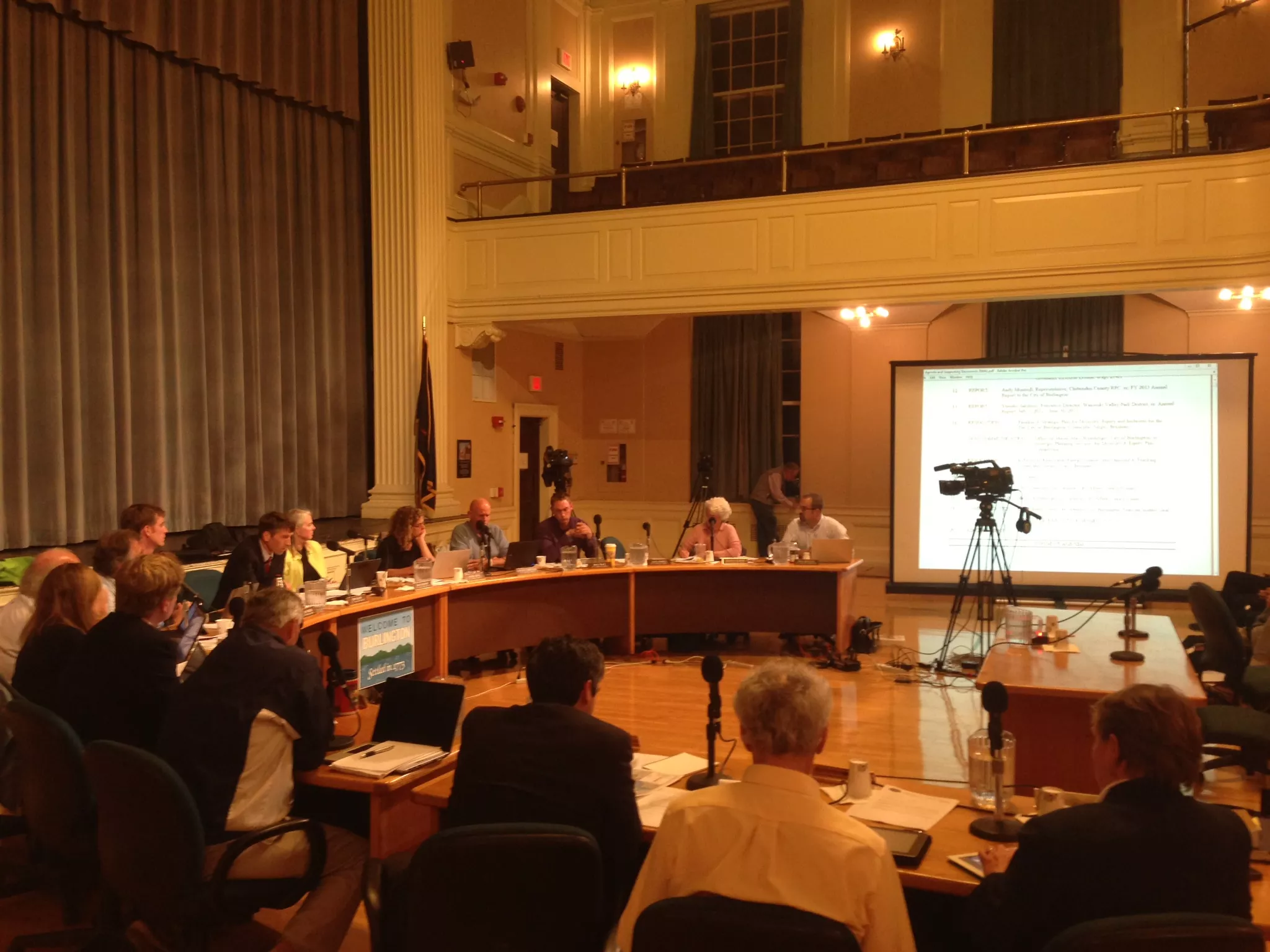
After 10 months of debate over how to redraw its own electoral districts, the Burlington City Council agreed in concept Monday night to a plan that would shrink the body from 14 members to 12.
But even after it became clear the plan would move forward, the council found something new to bicker about: precisely who came up with it.
One faction credited Burlington resident George Gamache, who died in July. Others credited resident Robert Bristow-Johnson. Another said Mayor Miro Weinberger came up with the plan, while yet another said it was "drawn up at the 11th hour by councilors" and wasn't properly vetted by the public.
Whoever conceived of it, the proposal was brought to life by an unusual faction of Progressives, Democrats and the council's sole Republican — all of whom hail from the city's New North End and Old North End. Democrats and independents representing the city's more southerly wards opposed it.
The vote was 8 to 6. The plan will now go to the council's Charter Change Committee, which will flesh out its details. If the council approves those, voters will have a chance to approve or reject it next March.
Sunday, September 22, 2013
On Monday night, the Burlington City Council will consider a complicated compromise on redistricting that as of Sunday was just one vote shy of having majority support.
This proposed reconfiguration of the city's political boundaries already has the expressed backing of seven of the council's 14 members. Three Democrats, three Progressives and the council's lone Republican are behind the plan, giving it the gloss of tripartisan appeal.
Geographically, however, support for the scheme is so far confined to the Old North End and the New North End. It remains to be seen whether councilors representing other parts of the city will go along with the proposal to establish eight wards and four "precincts" to be represented by a total of 12 councilors — two fewer than today. The council's Monday agenda also includes five alternative plans, each of which has the listed support of at most a single council member.
One of the virtues of the "hybrid" proposal is that it keeps the four current Old North End and New North End wards intact and distinct, notes Progressive Councilor Max Tracy. Residents in those two sections of Burlington have indicated they do not want their neighborhoods to be combined as a result of the redistricting process, Tracy says.
Friday, September 20, 2013
Citing a reputation for "fairness and rigor, as well as his demonstrated commitment to ensuring that our judiciary serves the needs of Vermonters," Gov. Peter Shumlin this morning announced the appointment of Superior Court Judge Geoffrey Crawford to be the next Vermont Supreme Court justice. Crawford will replace former Justice Brian Burgess, who retired on August 1.
Crawford (seen right, in bowtie, with the HowardCenter's Bob Wolford) was appointed to the Chittenden County Superior Court in 2002 by then-governor Howard Dean. Previously, he was a partner in Burlington law firm of O’Neill Crawford & Green, where he handled a variety of civil matters, including commercial litigation and personal injury cases.
As a superior court judge, Crawford is known for his compassion and "having a strong legal mind," says Vermont Law School Professor Cheryl Hanna. She says she was particularly impressed with the way Crawford handled the case of Christopher Williams, the man convicted of murdering Linda Lambesis and Alicia Shanks in the August 2006 Essex school shooting. Hanna says that Crawford showed "real judicial leadership" in the case, which affected not only the victims and their families, but the entire community.
"He's considered to be a real humanist," she adds, "someone who really cares about people who are underserved."
Crawford's empathy extends beyond office hours. He currently serves as a board member of Dismas of Vermont in Burlington, which helps prison inmates integrate back into their home communities.
Crawford was featured prominently in a December 6, 2006 Seven Days cover story about his service on Vermont's first-ever mental health court, titled, "A Kinder Court: Chittenden County rethinks its approach to mentally ill offenders." The article made note of Crawford's ability to connect with the people who entered his courtroom, to whom he referred not as "defendants" in need of punishment but as "clients" who required counseling and other support services.
A graduate of Yale University and Harvard Law School, Crawford lives with his wife in Burlington, where they raised five children.
Spring training in September?
That's one way to think of the reorganization meetings that Vermont's major political parties are currently holding in towns around the state.
Like baseball's pre-season exhibition games, these gatherings generally attract only fanatical followers of the sport. And in addition to prepping for the big contests ahead, the teams use these laid-back occasions to honor retired heroes, rev up excitement for the current roster and showcase promising rookies.
At Burlington's Democratic Party reorganization meeting last night, for example, past stars such as former city councilors Bill Keogh and Ed Adrian schmoozed with members of today's council lineup, including Tom Ayres, Chip Mason, Norm Blais and team captain Joan Shannon. State lawmakers representing Burlington districts, including Joey Donovan (pictured below with Ayres), were on hand to report on their doings in Montpelier.
Mayor Miro Weinberger was hailed as the all-star slugger for the local Dem side. He smiled modestly in response to the ovations he received before, during and after his animated 10-minute pep talk to the 50 or so faithful gathered in Burlington City Hall. The Contois Auditorium spotlight was also aimed briefly at Emily Lee, who almost made the council team in last March's election and seems poised to try again soon.