

Wednesday, July 10, 2013
Sanders says he believes an Egyptian coup was, in fact, a coup, but he won't say whether he believes the U.S. should withdraw aid.
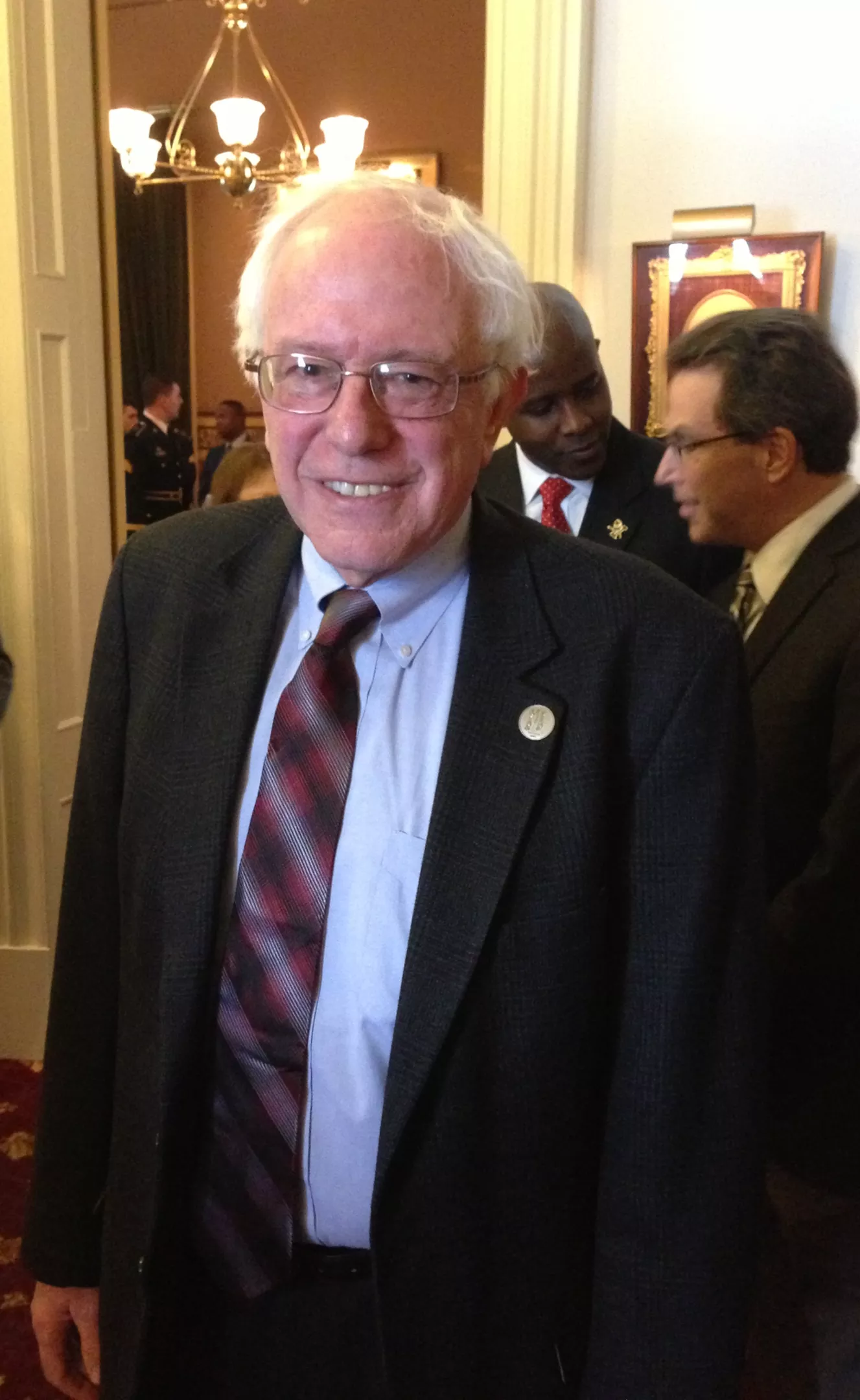
As we wrote in this week's Fair Game, Sen. Patrick Leahy (D-Vt.) believes U.S. law clearly states that foreign aid "is cut off when a democratically elected government is deposed by military coup or decree." And, according to spokesman David Carle, he believes the toppling of Egyptian president Mohamed Morsi last week constitutes a coup.
But asked whether that means Leahy believes the U.S. should cut off $1.3 billion in annual aid to the Egyptian military, Carle wasn't quite so clear.
"It's a fluid situation at the moment and he understands the Administration wanting to wait for some clarity," Carle told us. "The situation in Cairo is cloudy, but the law itself is clear."
We focused on Leahy's stance in the column because the guy plays a central role in the debate: As chairman of the Senate Appropriations Subcommittee on the Department of State, Foreign Operations and Related Programs (phew, now that's a name!), he writes the budget for U.S. foreign aid programs.
But where does the rest of Vermont's congressional delegation stand?
Congressman Peter Welch's (D-Vt.) position is pretty straightforward.
"The Egyptian military removed from office the democratically elected — if failed — leader of Egypt," he said in a written statement. "By any definition of the word, this was a coup and it appears, under current law, that future American assistance to Egypt is prohibited."
As for Sen. Bernie Sanders (I-Vt.), his answer to our first question — whether Morsi's toppling constituted a coup — was crystal clear.
"Yes," he said in a written response. "When the military overthrows a democratically-elected government it is called a coup."
But asked in a follow-up email whether that means the U.S. should withdraw its aid to Egypt, as the law stipulates, Sanders declined to answer.
"I'm not sure we're going to have any more at this point," Sanders' spokesman, Michael Briggs, responded.
Oh. Okay.
Tags: Senator , Bernie Sanders , foreign policy , Recommended Reading , Web Only , Image
Tuesday, July 9, 2013
Opponents of the F-35 made emotional appeals Monday night in a failed attempt to persuade the South Burlington city council to reject local basing of the fighter jet. On Tuesday night they summoned scientific data to reinforce their argument that noise from the planes is harmful to human health.
At a forum entitled "Last Call for Kids," three Vermont medical experts warned that the F-35 will have potentially acute physical and mental consequences for those living in areas subject to the highest decibel outputs.
Citing a 2011 World Health Organization study, University of Vermont nursing school professor Judith Cohen listed some of the possible impacts: "headaches, tiredness, irritability, impaired intellectual function, inability to complete tasks." Noise levels produced by the likes of the F-35 can cause "cognitive impairment" in children, Cohen added, saying "reading, attention span and learning" may all be adversely affected.
Dr. John Reuwer, an emergency and occupational medicine practitioner in South Burlington, reduced the data to a simple formulation: "The F-35 is bad for our children's health." The effects are such, Reuwer added, that "allowing this plane to come here is like encouraging our children to smoke."
Updated below with comment from Pam Mackenzie explaining her vote.
South Burlington grandmother Carmine Sargent, an opponent of the plan to base F-35 fighter jets at the airport near her home, lamented recently that so few of her neighbors were speaking out against the plane.
Dozens of them spoke out on Monday night.
Well over half of the 80-plus South Burlington residents addressing a special city council meeting urged the five-member body to reaffirm its earlier stand against the F-35 "bed-down." Despite those occasionally emotional pleas, the council voted 3-2 in support of the basing plan at the chaotic conclusion of a three-and-a-half-hour meeting in the Chamberlin School gymnasium initially attended by about 250 local residents.
A few of the roughly 150 attendees still present in the uncomfortably warm gym at 9:30 p.m. shouted objections as council chair Pam Mackenzie refused to explain her decisive vote on the divisive issue. Mackenzie also would not explain why she alone among the councilors declined to state the reasons for her vote.
Mackenzie sided with councilors Pat Nowak and Chris Shaw, both of whom had soundly defeated F-35 opponents in local elections in March. Council members Rosanne Greco and Helen Riehle opposed the basing plan.
Prior to voting "hell, no," Greco said she was "shocked" that her colleagues would want to bring the plane to South Burlington "after all we've heard tonight." Greco, a retired Air Force colonel, drew a standing ovation after declaring that "blind acceptance is not patriotism."
Monday, July 8, 2013
Jean Szilva, left, an F-35 opponent, in an animated discussion with supporter Tony Augostino. The Winooski residents were among the more than 50 who spoke before city council Monday.
After two hours of public discussion overwhelmingly opposed to basing F-35s in Vermont, it remained unclear how the Winooski City Council will vote on the issue — or whether it will submit additional comments to the Air Force before a July 15 deadline for public feedback.
The council delayed any action until Wednesday after hearing from more than 50 Winooski residents, only five of whom voiced explicit support for the basing. The vast majority said the warplanes, which would replace F-16s currently based at Vermont Air National Guard base at Burlington International Airport, threatens health and quality of life in the city.
Winooski resident and activist Eileen Andreoli spoke to the council alongside a sign she made using a quote from the Air Force's most recen Draft Environmental Impact Statement.Even as Winooski residents testified, the South Burlington City Council was voting Monday evening to reverse a previous vote and officially support basing F-35s at BTV, over the objections of many city residents.
Arica Bronz, who co-owns a duplex in Winooski and has children in JFK Elementary School, told the council she was extremely happy to have her children in the school system, but wouldn’t accept the change.
“If the F-35s come to Winooski,” she said, “I will find a way to leave.”
Another resident, Dan Treinis, also said he would leave Winooski if the jets were based at BTV.
Many others were vehemently against the F-35s and encouraged the City Council to send a strong message to the Air Force on their behalf.
Resident Greg Premo said he worried the value of his home would fall with the increased noise from the new jets.
“I urge you not to be a laissez-faire city council,” he said to a panel of three city councilors and Mayor Michael O’Brien.
Abe may have been honest, but he was a snooper too. In an op-ed piece appearing in Saturday's New York Times, St. Michael's College journalism professor David Mindich blows the whistle on Lincoln's extensive domestic spying operation.
The communications-interception program approved by Lincoln in 1862 was similar in scope, if not in technology, to the systematic surveillance undertaken by President Obama's National Security Agency. Mindich notes that while the current operation may be alarming, it is not — despite what many commentators have claimed — "unprecedented" in American history.
Edwin Stanton, Lincoln's secretary of war, got the go-ahead from the 16th president for a plan to take complete control of the nation's telegraph lines, Mindich relates. Stanton was thus able to "keep tabs on vast amounts of communication, journalistic, governmental and personal," the prof writes. And the head of the Department of War "ultimately had dozens of newspapermen arrested on questionable charges."
But Mindich adds that he wasn't appalled by Stanton's requests to Lincoln for sweeping powers of surveillance. Upon unearthing these documents in the Library of Congress in the 1990s, Mindich recalls, "I accepted his information control as a necessary evil." Given the cause for which the Union was fighting, "the benefits of information monitoring, censorship and extrajudicial tactics, though disturbing, were arguably worth their price," Mindich tells his Times readers.
There's a kicker, though.
"Part of the reason this calculus was acceptable to me," Mindich continues, "was that the trade-offs were not permanent. As the war ended, the emergency measures were rolled back. Information — telegraph and otherwise — began to flow freely again."
Moral of the story: To protect privacy, put an end to the wars that the government cites as justification for its snooping activities. "If you are a critic of the NSA's surveillance program," Mindich reasons, "it is imperative that the war on terror reach its culmination."
Read Mindich's op-ed here.
Friday, July 5, 2013

The New York Times on Friday became the latest national news outlet to cover Vermont's long-simmering fight over whether the state will host a squadron of F-35 fighter jets.
In an A13 story, Times freelancer Theo Emery doesn't break any new ground, but he captures the irresistible drama of the situation: A divided city fights over whether to support "our guys" — as pro-F-35er Nicole Citro puts it — or those who would be bombarded by the plane's noisy takeoffs. Vermont politicians line up in favor of the basing, while others decry undue political interference.
Etc., etc.
While the themes of Emery's story may be familiar to anyone living in the Green Mountain state — or, at least, here in Chittenden County — it's surely news to many of the Times' 1.87 million subscribers. No doubt that will further elevate this local fight into a regional story with national legs.
You can read the story here.

Who won and lost the week in Vermont news and politics?
Lobbyists, flag thieves, health care haters, jets, the news and maybe you!
Behold, the Scoreboard for the week ending Friday, July 5:
Winners:
Dzemila Heco — Nearly six years after an accident on Route 15 in Essex rendered her paraplegic, the Essex Junction woman won a $43.1 million verdict in her lawsuit against car seat maker Johnson Controls. The Burlington Free Press' Sam Hemingway, who first reported the story Monday, quoted a legal expert calling the verdict the largest in state history.
Vermont businesses — They'll pay less in unemployment insurance taxes now that the state has repaid a loan from the U.S. Department of Labor. Runner-up loser: Unemployed workers, whose benefits were capped at $425 at the height of the recession.
Health care reform haters — Vermonters for Health Care Freedom scored a rare round of press hits this week when it circulated a letter written by. U.S. House Oversight and Government Reform Committee chairman Darell Issa (R-Calif.) taking aim at the state's new health care exchange.
Davis love — Gov. Peter Shumlin jumped on the #TeamWendy bandwagon last week when he called Texas state Sen. Wendy Davis to congratulate her on her famed filibuster to halt an anti-abortion bill. Does his call mean the Democratic Governors Association, which Shumlin chairs, is trying to recruit Davis to run for governor? Not necessarily. Shummy dodged that question at a press conference earlier this week.
Stannard love — VTDigger's Andrew Stein doled out the love for lobbyist extraordinaire Bob Stannard in an unsurprisingly entertaining exit interview this week. Is this the last we'll see of the Manchester native in Montpelier? I highly doubt it.
F-35 publicity — First came the Boston Globe. Then Harper's. Now the New York Times.
Losers and ties after the break...
Tags: The Scoreboard , Web Only , Image
Wednesday, July 3, 2013
Notice anything different about Seven Days' print edition this week? There are a lot fewer words — and a lot more cartoons.
This week, we decided to give our keyboards a rest and tell stories in graphic form. As co-editor Pamela Polston explains, we weren't quite sure how to do an all-cartoon issue at first. But we figured it out along the way, and we think the results are pretty fantastic (thanks mostly to the excellent cartoonists.)
This is an issue you'll want to pick up in print. But if you can only read it online, here's what's in news:
- Vermont's best-known undocumented migrant is a 23-year-old Mexican named Danilo Lopez. He's made quite a splash in Vermont, but the feds want to deport him by July 6.
- Chittenden County currently ships its sewer sludge to New York. But do we really know what's in that stuff?
- Who knew, but state Sen. Mark MacDonald (D-Orange) is the quite the political cartoonist, and we've collecting a sampling of his drawings from the 2013 session.
- And in Fair Game, Paul Heintz and Tim Newcomb team up to examine Macadam Mason's Taser death one year later — and whether Vermont will ever change its stun-gun policy.