

Friday, June 26, 2015

Anyhoo, stay tuned for more info on that. In the meantime, dig on some fresh jamz.
Ellie (Official Lyric Video) from Pours on Vimeo.
Tags: Pours , Bryan Parmelee , Chris Shar , Image , Video , Web Only
Thursday, April 30, 2015
Tags: cannabis related , Image , Video , Web Only
Monday, March 23, 2015

Shot at Burlington’s Memorial Auditorium during this year’s Golden Gloves tournament, the video, for the song “Beaten Down” from the band’s 2014 album The Next Instead, places the band members right inside the square circle. Though the video uses boxing to literalize the song’s central metaphor, the musicians leave the fighting to Golden Glovers Anna Gagnon and Hannah Rodrigue. A peaceful, if rockin’, bunch are these Swalers.
Tags: swale , beaten down , music , video , boxing , golden gloves , Image , Web Only , Video
Thursday, January 29, 2015

That song was a sneak peek at the ascendant group's forthcoming debut album, The Dance. With about a month-and-half to go before that record hits our eager ears, Mark Daly and Co. are teasing us yet again with another cut from the record, "I Know." It's an irresistibly catchy song that proves we were right: 2015 is already pretty rad.
So, as promised in this week's edition of Soundbites, here is the debut of Madaila's new video, "I Know."
Tuesday, January 20, 2015
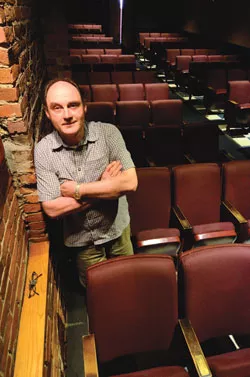
Updated at 5:20 p.m. to include an interview with Terrence Youk, below:
It's one of the few, the proud … the last surviving Vermont video stores. And this Valentine's Day, Montpelier's Downstairs Video will close its doors for good.
In a message sent this afternoon to members and friends of the Savoy Theater, Terrence Youk — who owns both establishments — explains the reasons for the closing:
It will likely come as no surprise that the video store has finally reached the end of its profitability. We have kept it going just on fumes but now it is becoming a liability for the Savoy to keep it operating. We will be closing the doors for good on February 14, 2015.
Tags: downstairs video , closing , savoy , terrence youk , video rental , video stores , vermont , movies , film , Image , Web Only
Monday, February 3, 2014
One career ago, I was a professor of film studies. I gave that up to move to Vermont and write for Seven Days, but movies will always been my first love. In this feature, published occasionally here on Live Culture, I'll write about the films I'm currently watching, and connect them to film history and art.
When the fondly remembered cult film Heathers was released in 1988, I was only a year or two younger than its main characters, who are high school juniors and seniors. My friends and I loved it and talked about it often — especially when cable and dear old VHS gave us the chance to watch it again and again. And even though our own high school afforded us unlimited opportunities to observe the cruelty of the Popular Kids and the thoughtless acts engendered by cliquishness (the film’s chief satirical targets), I can say with certainty that, still, we didn’t fully “get” Heathers.
I watched the film a few nights ago for the first time in at least 15 years. It holds up quite well, I was happy — and somewhat surprised — to see. More on that below.More surprising was how thoroughly the movie’s little nuances had been burned into my brain. This was apparently a film that made an impression on me, as I found myself, even after that long hiatus, able to recite favorite lines of dialogue in perfect sync with the actors. The film is endlessly quotable. Phrases such as “What’s your damage?” (a now-common expression that I think was coined for the film); “I love my dead gay son”; and the too-clever-by-half “Our love is God. Let’s go get a Slushie” really do embody Heathers’ bitterly satirical tone.
The best, though, is still “Dear diary, my teen angst bullshit now has a body count,” which is duly recognized as the film’s most iconic line. Poetry, that.
The script’s cleverness, which I remembered sort of generally, is only part of the reason I was surprised that Heathers still comes off as witty and satirical, 25 years (gulp) after it was made.
Cinema is often regarded as a “director’s medium” rather than a “writer’s medium.” Scripts are of obvious importance to movies, but in both popular and critical discourse, directors are usually credited with creating a film’s look and style. And not all directors write their own films.
Heathers was written by Daniel Waters and directed by Michael Lehmann. It’s tempting to assign most or all of the pleasure we may get from the film to Waters’ acerbic wit and keen ear for genuine-yet-stylized dialogue. And it really is a clever, funny script.
To my surprise, though, I found the film quite well directed, too. The film’s visual style was more sophisticated than I remembered — probably because I didn’t pay much attention to such things when I was in high school.
One of the clearest examples is Lehmann’s use of a simple, bold primary color scheme to identify, distinguish and jokingly liken the three titular Heathers: One gets bluish-green, one gets yellow, and the one who currently sits at the tippy-top of her school’s pecking order is identified with red. Red clothing, red bedroom, even a red croquet ball. Using simple, playroom colors shows how juvenile these girls really are; and, though the colors are different, they are all similarly bold and brassy, indicating an underlying similarity or, more strongly, a mindless sameness. Which is exactly the point.
Three Heathers, three colorsIf the croquet balls are the orbs, the red hairband is the crown. As it gets passed from Heather to Heather (and ultimately to Veronica, Winona Ryder’s character), it shows us which girl is “in charge.” A simple device, and admirable for that reason. A gesture like this is so easy thing to do — and such a clean, graspable way of visually communicating narrative information — that it’s surprising so few directors do it.
To continue with the color scheme, it’s reduced to pretty much black and white in the scenes at the home of J.D. (Christian Slater) and his father. Their house is furnished with stark, colorless, modernistic furniture, which reads to us as “cold” — an apt adjective for the father-and-son relationship.
It’s tempting to align J.D. with, say, black, and his father with white, though that would be too simple. Heathers is much more ironic in tone than that. (We’re cued to the irony right from the start, when an idyllic scene of three charming young ladies — the Heathers — playing croquet is undermined when the girls willfully stomp over the flowers neatly arranged in the garden.)
Though J.D. and his dad plainly can’t stand one another, the film also makes a point of likening them strongly to each other. It accomplishes this at the level of dialogue and performance, having the son deliver “paternal” clichés in an ironic voice, and the father speak as if he were a teenager. An example: J.D. says, sarcastically, as his father enters the house, “Why, son, I didn’t hear you come in.” A few lines later, his father responds in kind with, “Gosh, Pop, I almost forgot to introduce my girlfriend.”
Veronica reacts to this dialogue with revulsion, highlighting its creepiness. And it is creepy: We feel just as uncomfortable as she does. It’s also a smart and simple way to establish the frosty relationship — as well as the essential similarity — between the two.
All of which is simply to say that Heathers’ ironic tone extends beyond its script to the visual realm, in which the black-and-white scheme of this unhappy home also confirms these characters’ status as the outsiders they are. They do not belong in this town, a fact that the story’s ending confirms. In fact, Veronica, when she hears this unpleasant dialog, is granted her first clue that this J.D. character, whose cheeky misanthropy was at first so appealing, is actually more dangerous than are the Heathers.
The Dumptruck DoughnutThe visual pleasures of Heathers are a major reason the film plays so well for me now. And many of the film's elements that had lodged in my brain were, in fact, visual, not just lines of dialog. The lovely overhead shot of Heather No. 1 crashing through her glass coffee table; the Wham!-esque “Big Fun” T-shirts; the cow-tipping scene; and, most iconically for me, the moment when Martha “Dumptruck,” in her little motorized scooter, does a loop around Veronica at the far end of a high school hallway.
Seeing all these images again reminded me what an impression they made on me in high school, even if I didn’t realize it at the time. And I don't think Heathers ever received proper credit for its visual creativity.
Monday, January 13, 2014
UPDATES BELOW: 12/26/13 & 1/14/13
Though the semester is nearly over, a film class at the University of Vermont has welcomed a new student: acclaimed director Werner Herzog.
Herzog, who has been making films since the early 1960s and is best known for his films Aguirre, the Wrath of God; Grizzly Man and Cave of Forgotten Dreams, has been an artist-in-residence at Dartmouth College for the past semester, working with students and speaking at public screenings of his films.
UVM professor Peter Gruner Shellenberger, a visiting lecturer in film and photography, recently took some students in one of his filmmaking classes to Hanover to hear Herzog speak about his films. Shellenberger brought to the event a vintage Super-8 camera, preloaded with film and, at the Q&A session, asked Herzog if he would use the camera to make a film for the UVM students.
To Shellenberger's surprise, Herzog agreed.
"Did I think he would do this?" asks Shellenberger rhetorically. "Never in a million years. But, then, there’s a part of me that maybe knew that he would be open to it," he adds, referring to Herzog's reputation for unusual film projects.
Two weeks after giving Herzog the camera, Shellenberger received it in the mail, with a roll of unexposed film still inside it. Herzog also included a few unusual conditions:
What should happen is the following: please develop the film and hand it over to your students. My demand is the following: they have to make films, collectively or individually, which should include my footage. Obviously, they do not need to take everything, nor in the order I filmed the material.
The title of their film/films has to be WHERE’S DA PARTY AT?
In my footage this appears in one of the graffiti, and at least this portion of the text should appear in the film, or all the films.
Friday, December 6, 2013
A2VT are at it again. Almost exactly one year after showing their adopted Onion City home some love with the video "Winooski, My Town," the trio of African refugees turned "urban global" rappers cast a longing gaze toward their native soil with a lively new vid, "Africa (I'm Coming back to You)."
Directed and produced by Casey Clark, the new video was shot at various locations along the Burlington waterfront and features some nifty dance moves courtesy of the Roxy Dance Studio, a solo dancer by the name of Mimosa — she's the young lady on the rocks — and, as always, A2VT themselves.
Thursday, November 14, 2013
A couple months ago, local electro-pop songwriter tooth ache. — aka Alexandria Hall — released a rerecorded version of her debut LP Flash & Yearn, which was originally released in 2011. Ms. ache. has just unveiled a provocative new video for one of that record's signature cuts, "Matador."
Earlier this year, Hall dished to 7D about the song for a piece we did on local love songs. Here's what she said:
“Matador” is a glimpse at love as the game or sport or chase. In the song, the matador exercises more control over the situation, while the speaker, the bull, is the passionate, even desperate one, hurling herself at him despite love’s lances.
But the matador is in danger, too. So while it may seem like the bull is the “victim” of love, they’re both in this turbulent, dangerous, but showy and appealing zone. It’s this kind of chaotic but necessary ritual. It’s anxiety and anticipation … the drum machine’s urgency or the bass line’s hesitance.
Playing up the aforementioned love-as-sport angle, Hall's new video is set in a combination bowling alley/strip club — Shenanigan's in White River Junction, to be exact. (And, yeah, it's a real place.) Produced by Burlington's Sullen Belle Productions, it's an entertaining video that almost plays like a short film. It features bowlers, strippers, one of the greatest ironic T-shirts ever and one unfortunate fella laid to waste by a stiletto heel through the eye — perhaps a stylish allegory for bullfighting? Oh, yeah, there's a real live bull, too. (We hear his name is Ace.)
Here's the video, in all its delightfully sleazy glory. And, yes, some of the strippers are topless. So if naked lady parts offend, maybe skip this one. (Though frankly, we find the heel through the eye scene to be far more unsettling than a few passing bewbs.)
Tooth Ache | "Matador" [NSFW] from SULLEN BELLE productions on Vimeo.